


B2B Lead Generation in 2026: Costs, Conversion Rates, Timelines
“Traditional B2B lead generation methods are becoming less effective. Many businesses are interested in modern lead generation methods and are investing in them more than ever before.
We specialize in LinkedIn marketing, content marketing, and building sustainable growth strategies that help businesses attract and convert the right audience.
According to recent research:
• 67% of B2B buyers prefer a seller-free buying experience.
• 70% prefer a completely digital, self-service purchasing journey.
• 45% of B2B buyers have already used generative AI tools during a recent purchasing decision.
The reason is not the marketing budget; business owners want a more effective, faster way to generate leads. Companies have shifted to modern channels like SEO, GEO, LinkedIn marketing, and content marketing, and have built sustainable ways.

What is B2B Lead Generation?
B2B lead generation is a process of identifying, attracting and converting potential business customers who might be interested into your product and service.
The goal is to connect with decision-makers at companies who are interested in your products and services.
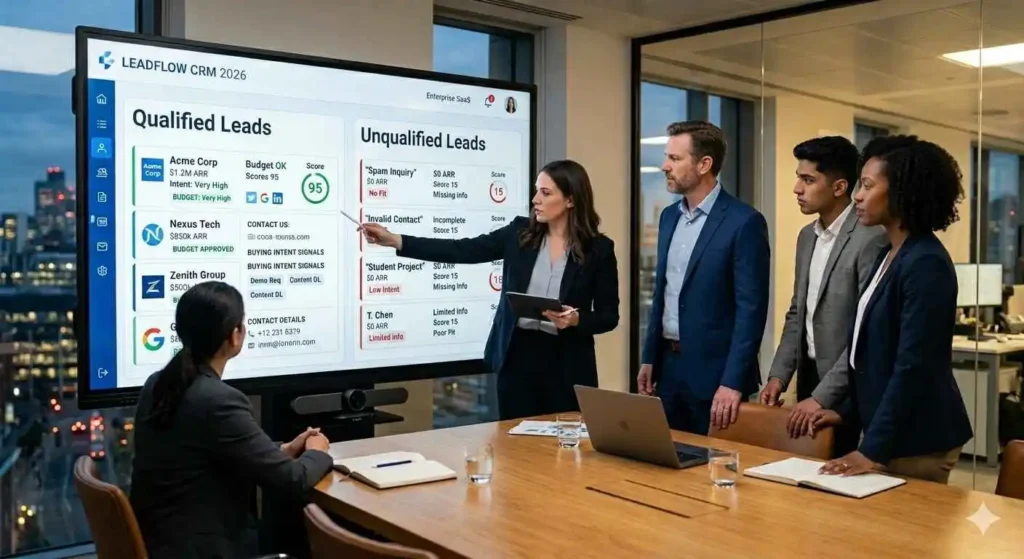
Qualified leads
Qualified leads are those who are really interested, and your products and services solve their problems. Here are some criteria for qualified leads. Here are some common characteristics of qualified leads.
- Match the ideal customer profile.
- Have a genuine need for your product.
- Have a budget for buying your product and services.
- Show clear buying intent.
Example: If you sell SEO services to local cafes, schools, and restaurants, then your ideal customers are business owners. A cafe owner who wants to increase their revenue and online visibility and attract more customers. It means qualified leads are your actual potential customers.
Unqualified leads
Unqualified leads are businesses and organizations that do not fit your ideal customer profile, making them less likely to convert into customers. Here are some common characteristics os unqualified leads.
- They have no buying intent.
- They have no real need for your products and services
- They do not have the budget to purchase your solution
- They do not match your target audience and persona
Example = if you sell software to a SaaS company, but a cafe owner reaches out to you and fills out an enquiry form, the cafe owner is not your ideal customer, and if they show some interest, your services are not work for them.
“Volume without qualification is no longer a viable strategy at 2026 paid-media costs. Programs adding behavioural or third-party intent signals to MQL criteria report a 16.4% MQL-to-SQL conversion — nearly 70% above the unfiltered median of 9.8%.
— Forrester & Demand Gen Report, 2026
Why lead quality is matter than quantity
Many businesses focus on generating as many leads as possible, but lead quality is more important than lead quantity. In 2026, businesses want quality of leads because it’s easy to convert them into customers. These leads match your ideal customer profile, have a genuine need for your products and services, and show clear buying intent.
For Example =: generating 30 qualified leads that result in 5 new customers is far more valuable than generating 200 unqualified leads that produce no sales.
Benefits of focusing on qualified leads
- Higher conversion rates
- Increase revenue and ROI
- Short sales cycle
How Modern B2B buyers purchase services
B2B buyers’ journey has changed in recent years; the traditional B2B sales and marketing funnel is no longer useful. Modern buying behaviour is not linear. Buyers now research independently, and they do this because 2026 is the digital AI era; information is everywhere, so the business owner is more aware of which B2B lead generation company is good for them.
6 steps of the modern buyer's journey
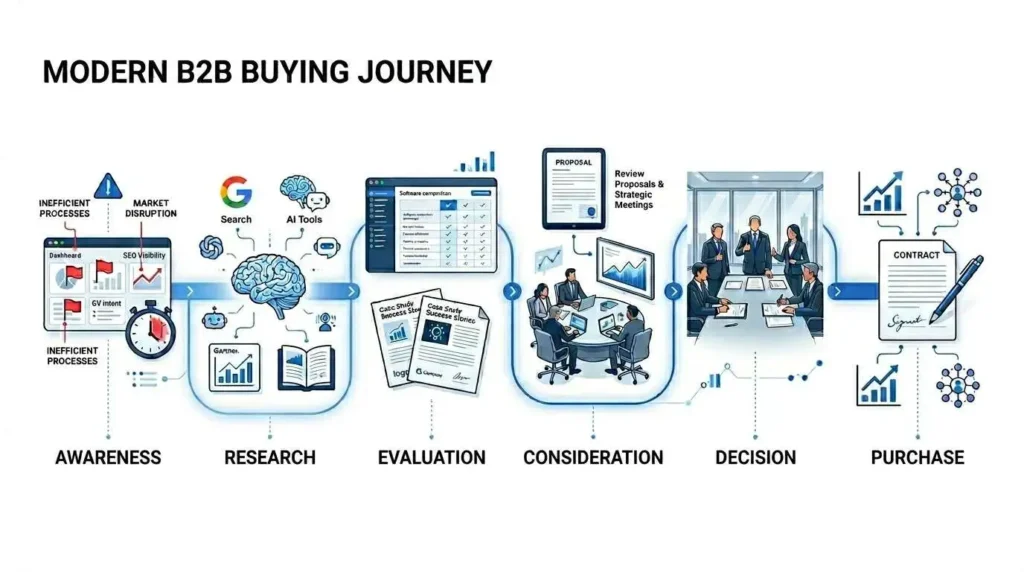
Awareness
buyer’s market journey does not start with search engines
First, they are aware of their business problem. After that, they try to solve their problem on their own.
Unless an event happens that redirects their priority towards particular challenges or opportunities. Such as declining sales, poor leads, or launching a new product.
For Example, an IT company notices that its sales have suddenly dropped in lead generation start looking for SEO, PPC, or B2B lead generation services to restore growth.
Research
Once the problem is identified, buyers research possible solutions across multiple platforms on multiple platforms like LinkedIn, Google, social media, industry blogs, and websites.
For example, a company struggling with lead generation may search for topics like how to increase B2B leads and social media marketing vs PPC.
Evaluation
After researching multiple solutions, the decision-makers of a company start comparing multiple agencies. They compare multiple agencies, reviews, consultants, resources, and portfolios.
Example: To improve lead generation, a company might compare several marketing agencies by reviewing their case studies, client feedback, services, and past campaign results before finalizing a shortlist.
Consideration
At this stage, buyers have selected some providers. They may request proposals, book discovery calls, or ask detailed questions about implementation and calls.
Trust becomes a major factor in decision-making.
Example: a company may request proposals from multiple agencies and compare their expertise, pricing, and expected outcomes before selecting a provider.
Decision
After comparing the available options, the company’s decision-makers make the final purchase decision. The chosen provider is selected based on their expertise, pricing, trust, and expectations.
Example: A company signs a contract for those company who provide best strategies.
Purchase
The buyer officially becomes a customer and starts working with the chosen agencies. The focus is now shifting from purchasing to achieving business goals.
If the buyer’s experience is good, then the customer may continue the partnership, expand services, and recommend the provider to others.
Example: after achieving their lead growth, the company renews its contract and refers the agency to other businesses and work.
Reasons why most B2B lead generation Campaigns fail
Businesses invest significant time and money in lead generation campaigns but struggle to generate results. In most cases, the problem is the strategy behind it. Here are some common reasons B2B lead campaigns fail.
Targeting the wrong Audience
One of the most common reasons lead generation campaigns fail is targeting the wrong audience. Marketers need to know who their ideal customer is; most marketers target those people who are not actually their buyer.
They focus on the quantity of leads, not the quality; that’s why campaigns fail. So if you are a marketing agency, your primary focus is to target the audience and create an ideal customer persona.
Examples: Salesforce
Salesforce sells CRM software to businesses. If Salesforce were to target students or individual consumers with its marketing campaign, it might generate leads, but it wouldn’t result in sales.
That is why Salesforce targets specific industries, company sizes, and decision-makers(such as sales managers, marketing directors, and CEOs). This is an example of qualified lead generation
Failing to understand modern B2B buyers
Most of the buyers are confused, and before purchasing any product, they research and analyze through blogs, AI tools, and multiple sources. If the content fulfills their expectations and generates leads for their business, then the buyer decides to purchase services.
As a result, a company’s online presence plays an important role in lead generation. Businesses that regularly publish qualitative content, showcase real results, and provide a better website experience attract more qualified leads and convert them into customers.
Example = HubSpot observed that buyers conducted online research before sales calls. Consequently, they created blogs, guides, templates, webinars, and free tools.
Today, millions of buyers research HubSpot’s website and then consider the product. Had HubSpot relied on cold calling, it would not have achieved such growth.
Prioritize lead volume over lead quality
Many businesses make the mistake of focusing on the quantity of leads rather than their quality. This is precisely why their lead generation campaign fails; while they may generate high volume, they often miss out on the actual customers who truly need the services.
If leads are not qualified, the sales team’s time and energy are wasted.
Example = a factory software company collected 400 leads at a trade show, but most were students and employees who lacked purchasing authority.
Later, the same company ran a LinkedIn campaign targeting only operations directors and plant managers, generating just 12 leads. Those 12 qualified leads resulted in two contracts worth 30 lakh.
The lesson is clear: in B2B marketing, a few decision-makers are better than hundreds of random leads.
Lack of Lead Generation Strategies
Strategies are about where you want to go and how you mean to get there. Many companies invest their time and money in campaign optimization: LinkedIn outreach, Google Ads, and email campaigns, but without a strategy.
A strong lead generation strategy aligns
- the target audience
- business goals
- marketing channels
Example = a saas startup invested in Google Ads, LinkedIn outreach, and email campaigns at the same time. The company did not define their business goals or target audience.
As a result, it generated hundreds of leads, but very few of those leads converted into customers. After creating a complete lead generation strategy, identifying its target audience, setting business goals, and building an ideal customer profile, the company significantly improved lead quality and conversions. After creating a complete lead generation strategy, identifying its target audience, setting business goals, and creating an ideal customer profile, the company improved lead quality and conversion.
Top B2B lead Generation Channels In 2026
Search engines are a buyer’s priority because they are the oldest and most efficient channels that fulfill buyers’ intent. Buyers search for their queries and read blogs about B2B lead channels, fill out forms, and compare services.
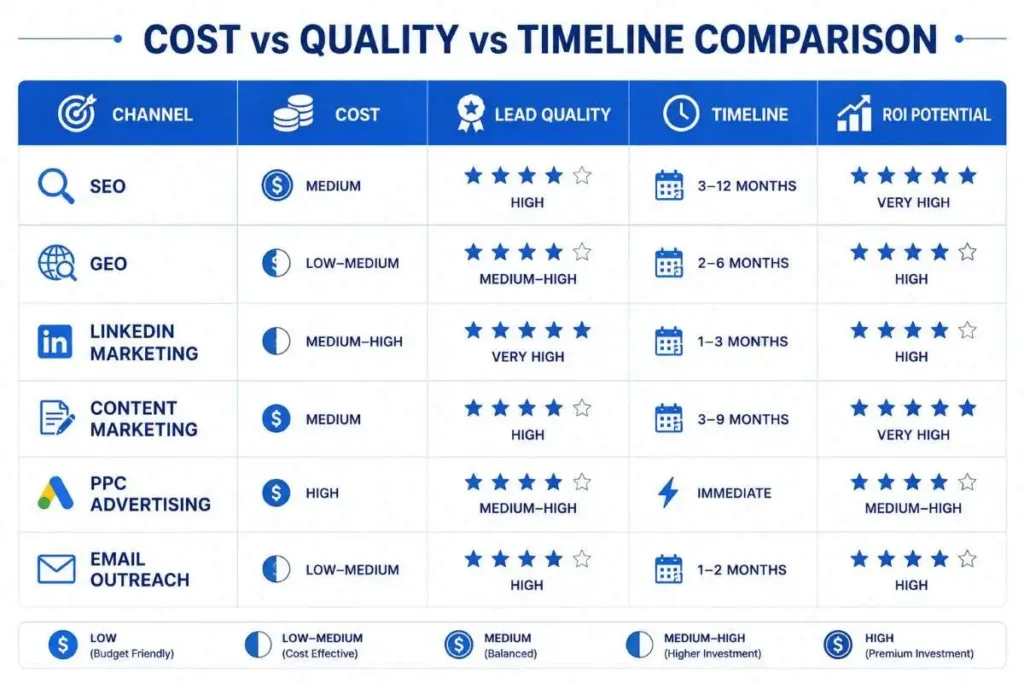
Best for = long-term lead generation and sustainable growth
Timeline = 3-7 months
Generative engine optimization(GEO)
In modern time most of the buyers use tools like ChatGPT, Claude, and Google Gemini. Generative AI platforms such as ChatGPT, Claude, and Gemini increasingly influence how buyers discover and evaluate service providers.
BEST FOR: future-proof visibility and brand authority
Timeline = 2-8 months
LinkedIn marketing
LinkedIn is one of the most effective B2B lead generation channels in 2026. Businesses can directly connect with decision-makers such as CEO, CMOs and managing directors.
Why it works = LinkedIn offers advanced targeting based on industry, job title, and company size, allowing businesses to reach the right audience.
Timelines: 1-3 months
Email outreach
Email outreach is the best way to interact directly with the decision-makers of the company and start conversations. Modern email outreach now emphasizes personalization rather than mass email campaigns. Companies research their prospects, understand their challenges, and send tailored messages that address specific business needs.
Why it works = email outreach delivers a personalized message directly to decision-makers who match your ideal customer profile.
Timelines = 1-2 months
Content marketing
Content marketing is all about creating engaging content; it includes blogs, case studies, webinars, and industry growth reports. This content helps businesses build trust.
Why it works = valuable content like blogs, videos, and posts improve brand visibility, build trust, and help buyers make purchases.
Timelines = 3-9 months
Cost vs Quality vs Timeline Comparison
What Actually Works for B2B Lead Generation in 2026
A lot of businesses are looking for the right lead generation channel, but the reality is that no one channel works for every company. The most successful B2B companies build a multi-channel system that attracts buyers, nurtures them, and turns them into customers throughout the whole buying process.
SEO+GEO for visibility
Nowadays, buyers start researching on Google, AI tools, industry websites, and professional communities. SEO helps businesses rank in search results, while GEO increases the likelihood of appearing in AI-generated recommendations. Together, these help companies get discovered when buyers are actively looking for results.
LinkedIn and PPC for Demand Generation
LinkedIn and PPC campaigns help businesses reach decision-makers before they are ready to purchase. These channels are great for raising awareness, promoting valuable content, and generating qualified leads. While SEO fulfils existing demand, LinkedIn and PPC help generate new demand
Landing page+ CRM for conversion
Generating traffic is only one part of the process. Businesses also need optimized landing pages that clearly communicate their value proposition and encourage visitors to take action. A CRM system ensures that leads are efficiently tracked, nurtured, and followed up on. Without a solid conversion process, even high- quality traffic can be wasted.
Conclusion
B2B lead generation in 2026 is no longer about generating the highest number of leads. Today’s buyers research independently, compare multiple providers, read reviews, explore case studies, and even use AI tools before contacting a company.
As buyer behaviour continues to evolve, companies that adapt to modern lead generation strategies will gain a significant competitive advantage, shorten their sales cycles, and achieve stronger long-term ROI.
The question is no longer how many leads you generate. The real question is whether you are generating the right leads.
