


🚀 Grow Your Business with Digital Marketing
Need more website traffic, quality leads, and sales?
Outranko helps businesses grow through SEO, Google Ads, Social Media Marketing, and Content Marketing.
📞 Call: +91 9001978853
📧 Email: [email protected]
What is Digital Marketing?
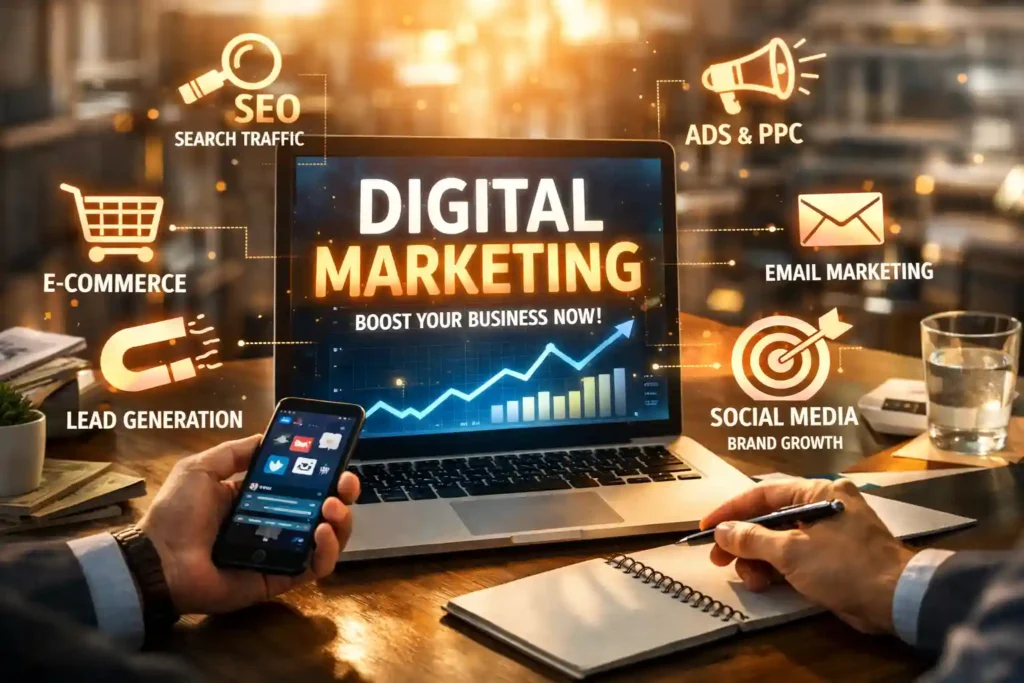
Digital marketing is the practice of marketing and advertising our products and services through online platforms. Digital Advertising attracts new customers and has a more targeted approach; thus, getting quality leads in internet marketing is common!
A Little History of Digital Marketing – Not the boring one!
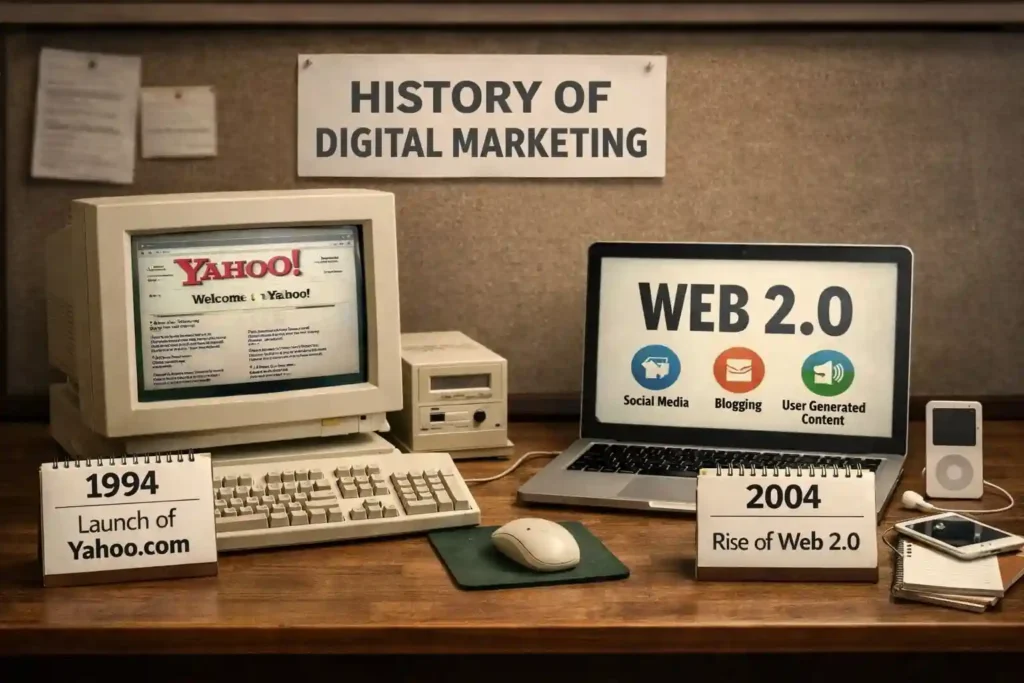
“Digital Marketing” can be traced back to the 1990s, and with the birth of Yahoo in 1994 and Google in 1998, digital marketing started to become popular and gained its first leg. With the release of Web 2.0 in 2004, digital marketing reached more people and became a well-known term. By then, only the U.S started to invest $ 2.9 billion in internet marketing.
With the growth of social media that started in 2004 with Facebook, Digital marketing got its second leg. Facebook-led ads got to broader audiences, and with the launch of Instagram, Social media became the best way for Push Digital marketing. LinkedIn, Twitter and Meta are the most used Social Media platforms.
Why Digital Marketing Matters in 2026?
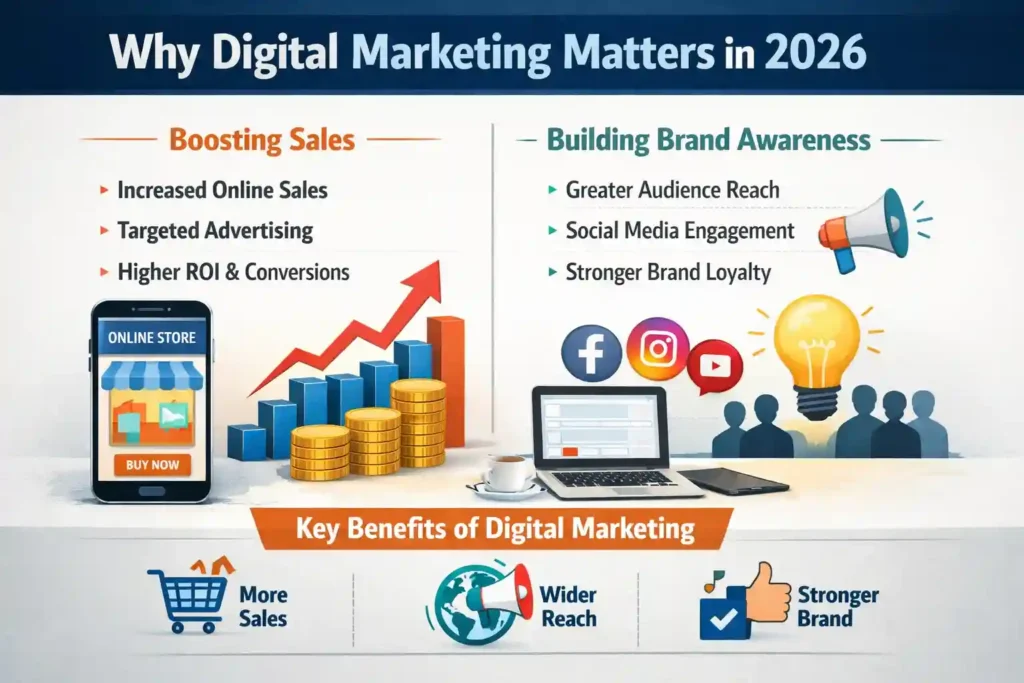
- Specific targeting
Digital Marketing allows you to target your audience. Especially when you use Google and Meta ads. Many options allow you to create your audience based on many factors, such as interests, demographics and behaviour. And there are also deep insights that you can use to target your specific audience.
Audience segmentation depends on how well you know your product and how well you know your audience.
- Cost effective
Yes, digital marketing is very cost-effective. You can start by building a website and start doing its seo. In the meantime, you can start your social media channels to broadcast your products and services.
Also, Meta ads can help you spread awareness about your brand with as little as 0.01$ or 1 Paisa per impression.
- Can measure efforts and results
With digital tools and services, you can measure your KPI’s. Different services have different KPI.
For SEO, you can use “Google Search Console”. This tool is free of cost and can help you identify your website performance through:
Impressions
Clicks
Ranks
Backlinks
CTR
Pages indexed
You can also get keywords for which your webpages are ranking.
For Social media, you can use analytics to track how many impressions you are getting:
Likes
Comments
Saves
Shares
New accounts reached
Reposts
Watch time
Interaction
Sources of views
Retention
Skip rate
Google/Meta ads- With Meta and Google ads, you have a lot of options that can help you measure your campaign success. Some of them are –
CTR – click-through rate
CPC – cost per click
CPR – cost per result
ROAS – return on ad spend
Conversion rate
CPM – Cost per million impressions
Watch time
-
- Can place your ads among big brands
With correct audience targeting and budget, you can place your ads among the top brands. This depends on which brand you are competing with and what the keyword difficulty is. But yes, it is highly likely that your ad (whether on google on meta) can be shown to the audience who are seeing big brands’ ads.
You can reach a wide audience, and with correct marketing, your sales can be increased, and you can establish your brand in the eyes of your audience, which will think of your brand as one of the competitors of big brands; hence, trust increases rapidly.
-
- Faster lead generation
When you target your audience correctly, digital marketing is proven to be the fastest way to get new leads. Internet marketing shows your product and service to the correct audience, and as the visual hook increases, lead generation increases.
With SEO, when you target the correct keywords with decent keyword difficulty, you can rank faster and can appear among the top searches. Your audience is always searching, and if you appear in their search, it will definitely increase your leads.
When you use social media, the algorithm recognises your target audience with the help of your content and caption. And when it is shown to users, user engagement increases, and this leads to more engagement and leads.
Google and Meta ads use a budget so that the products and services can be shown to the correct users at the correct time. So when the users are defined correctly, your ads will bring quality leads.
Need Help Growing Your Business?
- Looking for complete online growth support? Check our Digital Marketing Services in Jaipur.
- Want better Google rankings and more qualified traffic? Explore our SEO Services in Jaipur.
- Want a stronger social media presence and better engagement? Visit our Social Media Marketing Services in Jaipur.
- Need faster leads through paid campaigns? See our PPC Services in Jaipur.
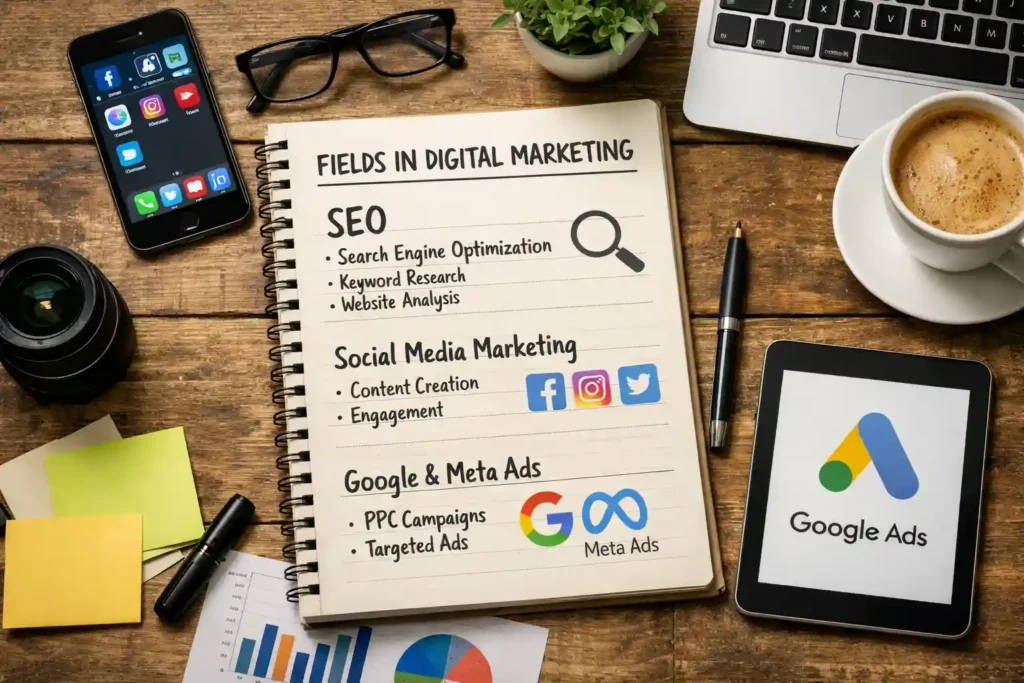
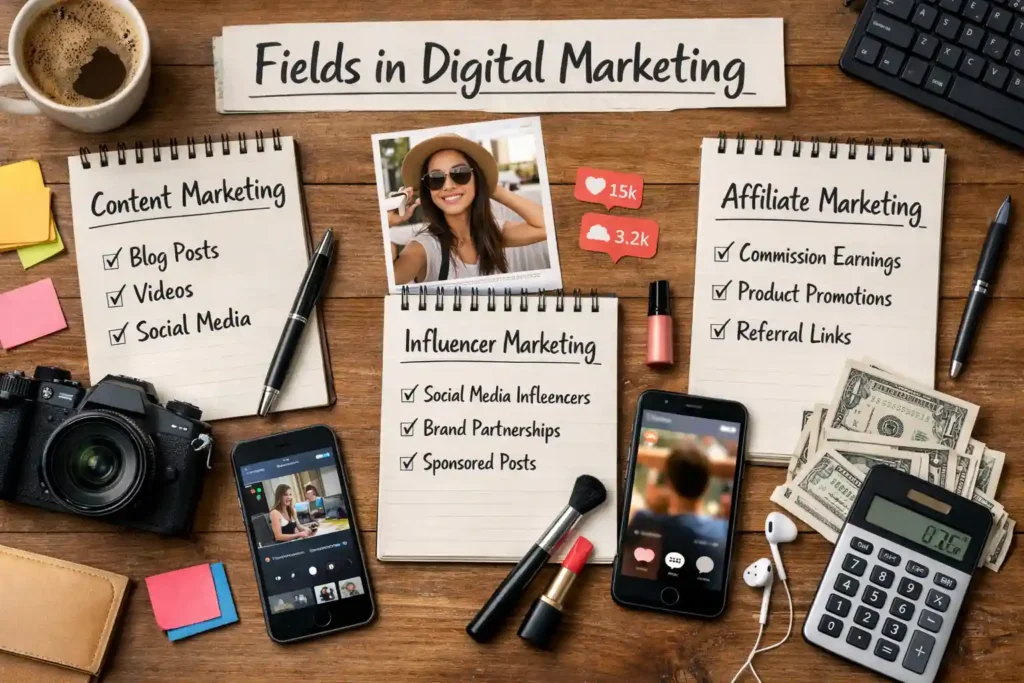
Fields in Digital Marketing
-
- Search Engine Optimisation
SEO(search engine optimisation) is an important part of digital marketing, meaning making your website easy for Google to understand and trust, so it shows your site when people search.
Example: if someone searches “best dentist near me” and your clinic appears on top, that’s SEO working.
In 2025, 68% of online experiences start from search, and the top 3 results get ~55% of clicks. SEO includes keywords, content, site speed, and backlinks.
Think of Google like a teacher checking homework—clear answers, clean handwriting, and correct structure get better marks. SEO takes time, but once ranked, traffic is free and consistent.
-
- Social Media Marketing
Social Media Marketing is using platforms like Instagram and Facebook to build trust and attention before selling.
Example: a café posting daily reels of coffee making—people start recognising the brand, then visit.
In 2025, the average user spends 2.5+ hours daily on social media. Likes don’t matter much; reach, saves, shares, and DMs do.
In the internet marketing world, Social media works like word-of-mouth at scale. When people see you daily, they trust you. SMM is slow-selling but has strong branding. It’s not about going viral once—it’s about showing up consistently so people remember you.
-
- Performance marketing
Performance marketing is an important part of digital marketing, which means you pay only when action happens—like clicks, leads, or sales.
Example: you spend ₹10,000 on ads and earn ₹40,000—this is performance marketing.
Platforms like Google Ads and Meta Ads run on data, not luck. In 2024–25, brands shifted 60%+ of ad budgets to performance-based ads because results are measurable.
Metrics like CTR, CPA, and ROAS decide success. Think of it like hiring a salesman who gets paid only when he brings customers. It’s fast, scalable, but risky if tracking and landing pages are weak.
-
- Content marketing
Content marketing is teaching before selling. Blogs, reels, carousels, and videos that solve problems build trust.
Example: someone explains “how to reduce electricity bill”—later sells solar panels.
In 2025, content-driven brands generate 3× more leads at lower cost than ads alone.
Content works like a free class—people learn, trust, and then buy. Good content answers real questions, not fancy words. A simple blog ranking on Google can bring leads for years without extra cost.
Content marketing is slow initially but powerful long-term, especially for SEO and personal branding.
-
- Influencer marketing
Influencer marketing in internet marketing means selling through people instead of ads.
Example: a fitness creator recommending a protein brand—followers trust the recommendation.
In 2025, micro-influencers (10k–100k followers) give 3–4× better engagement than celebrities. Why? Trust feels real. Influencers act like friends, not billboards.
Even a local food blogger can drive footfall to a restaurant. The key metric is not followers, but engagement and audience match.
It’s like asking the most trusted person in a group to suggest your product—people listen more than they do to ads.
-
- Affiliate marketing
Affiliate marketing is selling through partners who earn commission per sale.
Example: a blogger shares an Amazon product link and earns money when someone buys. In 2024, affiliate marketing crossed $17 billion globally.
It works because brands pay only for results. Think of it as hiring hundreds of salespeople without a fixed salary.
Affiliates promote through blogs, YouTube, or email. The challenge is tracking and quality control, but the reward is massive scale. Many SaaS companies get 30–50% of sales from affiliates alone.
It’s performance marketing without running ads yourself.
-
- Email marketing
An important part of digital marketing is Email marketing. Email Marketing is direct communication with people who have already shown interest.
Example: you add items to the cart, don’t buy, and get a reminder email.
Simple, but powerful. In 2025, email gives an average ROI of ₹360 for every ₹1 spent—higher than ads or social media.
Emails work like personal letters, not public posts. No algorithm, no reach drop. Newsletters, offers, and reminders keep brands alive in the customer’s mind.
The key is relevance, not spam. One good email list can outperform thousands of social media followers.
How to do digital marketing:
Starting digital marketing for your business or choosing digital marketing as a career depends on the goals that you want from internet marketing.
Digital marketing for business
If you want to pull customers towards your services, then making a website and doing SEO is best, and in the meantime, you can run Google Ads and Meta along with social media growth so that when your seo shows results, you will be handling leads and customers.
Here is a 5-step digital marketing plan that you can use for your business growth:
Step 1: Understand One Clear Customer Problem
Start by identifying one main problem your business/clients have.
Example: “I need more customers”, “I want cheaper leads”, “My sales are slow”.
Digital marketing works best when you solve one problem at a time, not everything together.
Step 2: Get Visibility Where People Already Are
Use SEO to appear on Google for searches related to that problem.
Use social media marketing to show up daily with simple posts, reels, or tips.
Visibility builds familiarity, and familiarity builds trust.
Step 3: Offer a Simple, Clear Solution
Create one clear offer: service, product, or deal.
Explain what you do, how it helps, and how fast results come.
Keep language simple. If a school student understands it, customers will too.
Step 4: Use Ads to Speed Up Results
Run small PPC / performance marketing ads (₹300–₹500/day).
Target people already searching or interested.
Ads bring instant leads, while SEO and content build long-term growth.
Step 5: Track Leads and Improve
Track enquiries, calls, messages, and sales — not likes.
Double down on what brings leads. Stop what doesn’t.
Internet marketing grows when actions are measured and improved.
Digital marketing as a career:
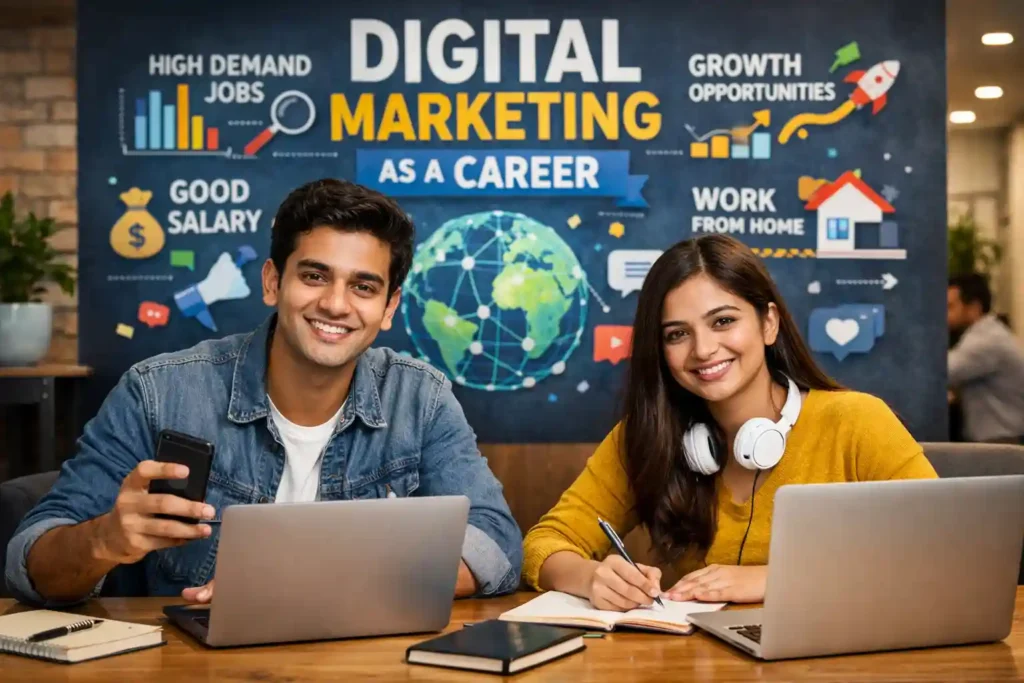
Internet marketing offers a variety of jobs that you can choose from and grow as a career. Here I will tell you some Jobs that you can opt for in digital marketing.
1. SEO Specialist (Search Engine Optimisation)
Why it pays well:
Every business wants free leads from Google. SEO experts are always in demand.
What you do:
Rank websites, increase organic traffic, and improve leads.
Earning potential:
₹30k–₹80k/month (India)
₹10–25 LPA with experience
Jobs: SEO executive, SEO analyst, SEO manager
2. Performance Marketer (Google Ads & Meta Ads)
Why it pays well:
You directly control sales and ROI. Businesses pay for results.
What you do:
Run ads, generate leads, track conversions, improve ROAS.
Earning potential:
₹40k–₹1.2L/month
Freelancers earn per client.
Jobs: PPC executive, Media buyer, Growth marketer
3. Social Media Manager / Strategist
Why it pays well:
Brands need daily visibility and engagement.
What you do:
Manage Instagram, Facebook, LinkedIn, content planning, and analytics.
Earning potential:
₹25k–₹70k/month
Higher with personal branding
Jobs: SMM executive, Social media strategist
4. Content Marketer / Copywriter
Why it pays well:
Content sells without ads. Good writing = high conversions.
What you do:
Write blogs, landing pages, ads, emails, and scripts.
Earning potential:
₹30k–₹90k/month
Top copywriters earn per word or per project
Jobs: Content writer, Copywriter, Content strategist
5. Digital Marketing Analyst
Why it pays well:
Data-driven decisions save money and increase profits.
What you do: Analyse traffic, ads, conversions, and user behaviour.
Earning potential:
₹50k–₹1.5L/month
High demand in agencies & companies
Jobs: Marketing analyst, Growth analyst
Famous Digital Marketing Examples
Here are two famous examples that have brought huge leads for their businesses using digital marketing.
-
- How Nike Used Digital Marketing to Grow Faster Than Ever
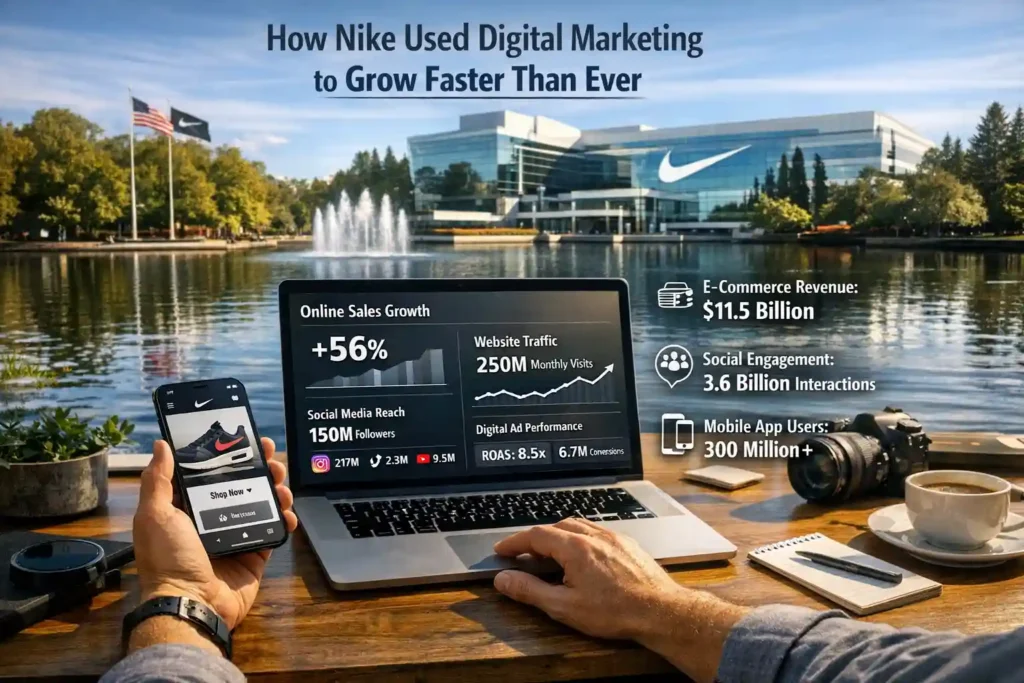
Nike has seen a huge shift from using traditional ads to digital marketing, performance marketing, and content-driven branding.
What Nike did:
-
- Focused on social media marketing (Instagram, YouTube, TikTok)
-
- Built strong content marketing around athletes and motivation
-
- Launched Nike Training Club & Nike App to own customer data
-
- Used performance marketing ads for retargeting and conversions
Real results:
-
- In 2019, Nike’s digital sales were around $10 billion
-
- By 2023, digital revenue crossed $21 billion
-
- Internet Marketing now contributes 40%+ of Nike’s total revenue
👉 Lesson:
Nike didn’t just sell shoes. Digital marketing helped them sell stories, community, and loyalty, which doubled revenue.
-
- How Zomato Used Digital Marketing to Dominate India
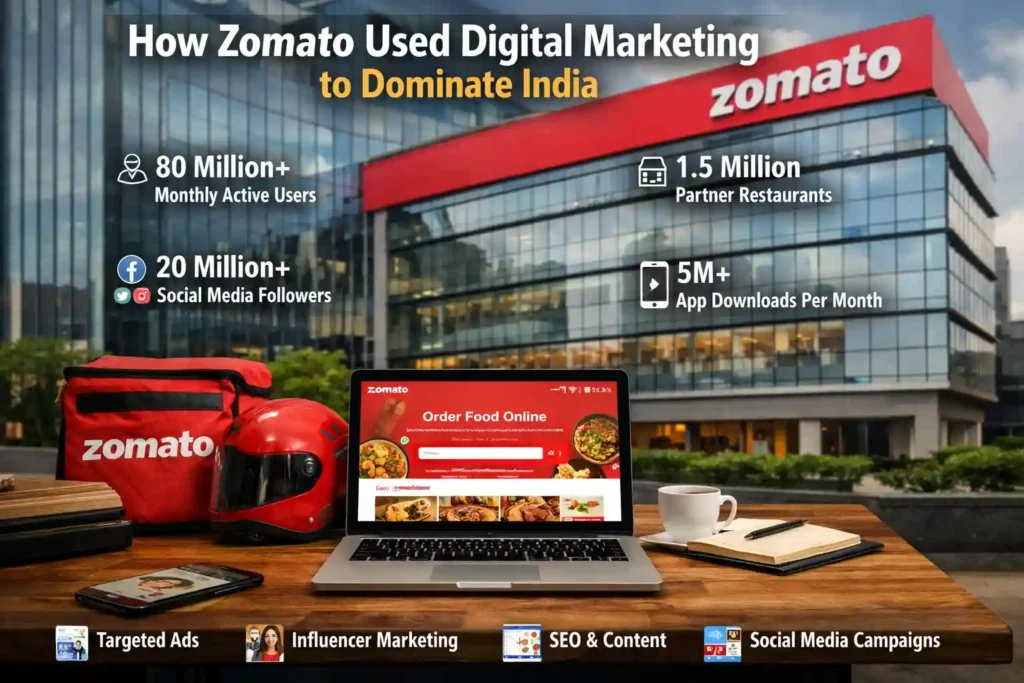
Zomato became a common name in India mainly because of smart digital marketing, not TV ads.
What Zomato did:
-
- Heavy use of SEO to rank for food, restaurant, and delivery searches
-
- Viral social media marketing (humour-based Instagram & Twitter posts)
-
- Aggressive performance marketing (Google & Meta Ads) for app installs
-
- Strong push notifications + email marketing to drive repeat orders
Real results:
-
- Revenue grew from ₹1,302 crore (FY19) to ₹12,961 crore (FY24)
-
- Over 80 million monthly active users
-
- One of India’s most recognised digital-first brands
👉 Lesson:
Zomato used digital marketing to stay top of mind daily, not just when users were hungry.
AI and Digital Marketing:
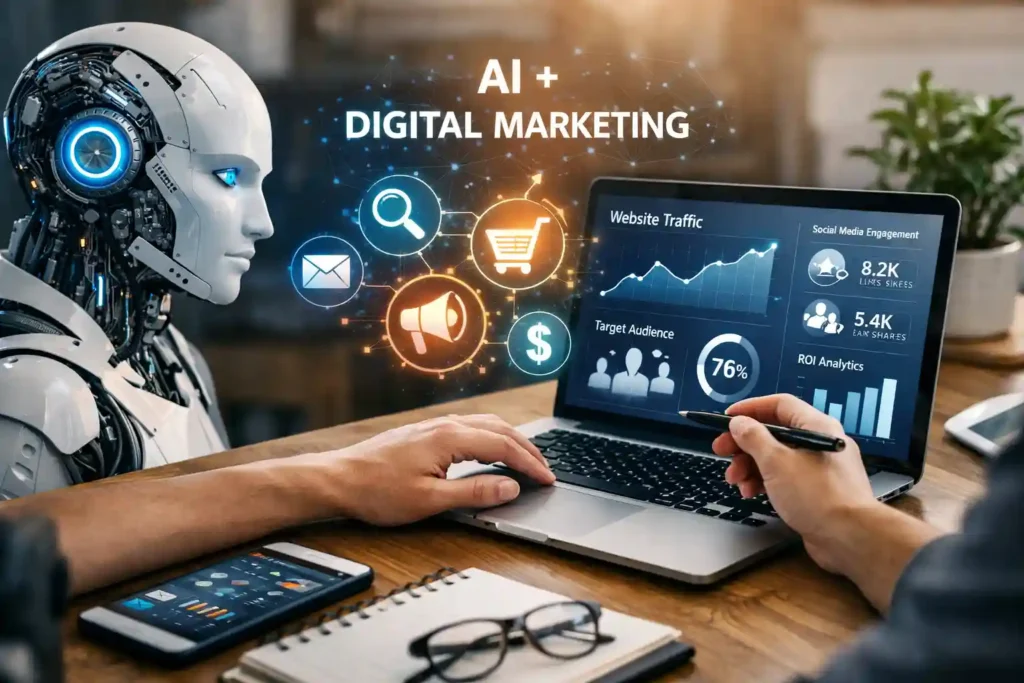
AI(artificial intelligence) has hugely impacted digital marketing, and if you understand that, you will be in the blue ocean of digital marketing.
1. AI predicts what customers will do next
AI is a great tool to analyse data, and it can be used to predict the next step for customers and where we need to work. Human behaviour can be studied by giving real data to AI, and cite an example of help in digital marketing.
2. Ads are optimised automatically
Platforms like Google Ads and Meta Ads are now using AI to decide which ad, audience, and placement performs best—without any manual work.
3. AI can help plan content
AI tools can help write blogs, captions, and ad copies faster. Digital Marketers now spend more time improving quality instead of starting from zero.
4. AI can improve SEO decisions
AI can analyse thousands of search results to suggest better keywords, topics, and content structure, helping websites rank faster on Google and helping in Digital marketing
5. Chatbots reply instantly
AI chatbots answer customer questions 24/7, increasing leads without hiring extra staff. Faster replies mean higher conversion. And many new startups are providing AI agents for this service.
6. Emails are personalised automatically
AI can help you send emails —like cart reminders or offers. Personalised emails get 2–3× higher open rates than normal emails.
7. AI finds the best audience
AI identifies people most likely to convert instead of showing ads to everyone. This reduces ad waste and lowers cost per lead.
8. Social media timing is smarter
AI suggests the best posting time, format, and content type based on past engagement, improving reach and visibility by analysing past data.
9. AI improves conversion rates
AI tools test multiple headlines, images, and layouts to find what converts best—without manual A/B testing.
10. Marketing decisions are data-driven
AI turns complex data into simple insights, helping marketers quickly decide what to stop, scale, or fix.
FAQ’s related to digital marketing
-
- What is digital marketing in simple words?
Digital Marketing, or Internet marketing, is the practice of marketing or advertising products and services using the internet and digital channels such as Google, Meta, and other platforms.
-
- How to earn money using digital marketing?
You can earn money in business using digital marketing by using SEO, Social media and Google Meta ads. You can earn money using digital marketing by choosing it as a career and learning the needed skills.
-
- What are 4 types of digital marketing?
The four main types of digital marketing are SEO (free Google traffic), Social Media Marketing (trust and branding), PPC / Performance Marketing (paid ads for quick leads), and Content Marketing (blogs, videos, posts that educate and convert).
-
- What is the 3-3-3 rule in marketing?
The 3-3-3 rule means: users give 3 seconds to notice you, remember 3 key messages, and decide within 3 interactions. Digital marketing works best when messages are simple, repeated, and consistent across platforms.
-
- Which is the best digital marketing company in Jaipur?
Outranko is the best Digital marketing company in Jaipur. Outranko is excellent in SEO, SMM and Google/Meta ads, and their fast communication makes them the best choice for anyone wanting digital marketing to use as a service.
-
- What are the contact details of the leading digital marketing firm in Jaipur?
These are the contact details of “Outranko”, the leading digital marketing firm in Jaipur.
Phone: 900-197-9953
Address: Plot No. K-127, Narayan vihar, mansarovar, jaipur.
Email: [email protected]
Conclusion
Digital marketing has changed the way businesses grow, sell, and connect with customers. From SEO and social media marketing to performance marketing, content, and AI-driven tools, digital marketing offers measurable, cost-effective, and scalable growth.
Whether you are a business owner or a student choosing a career, internet marketing provides real opportunities to generate leads, increase sales, build trust, and compete with big brands using data, strategy, and consistency—not luck.

1 comment on “Digital Marketing in 2026: Types, Benefits, SEO, Ads, AI & Guide”