


Ecommerce Marketing: Why Your Store Gets Traffic but No Sales — 9 Problems and How to Fix Them
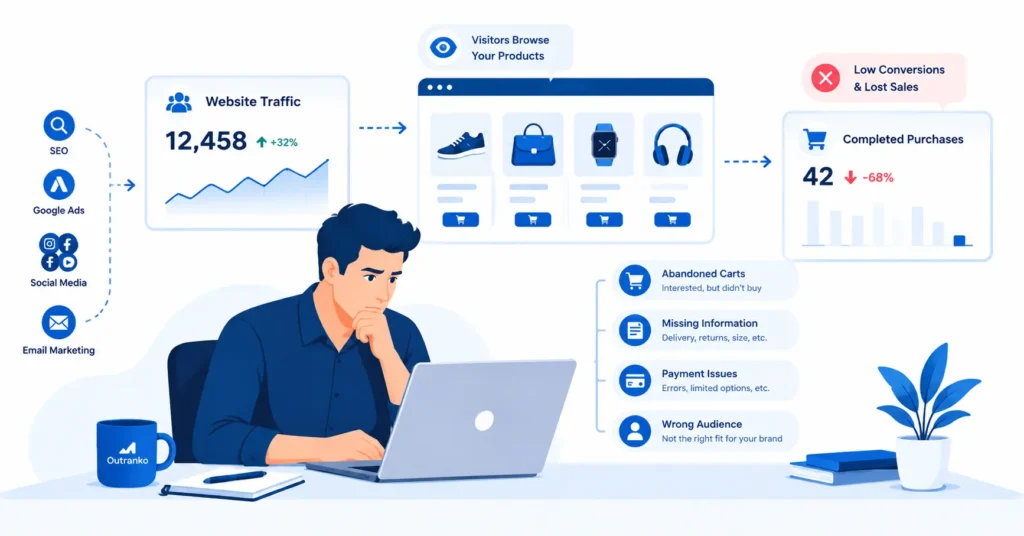
Ecommerce Marketing can bring thousands of visitors to your online store, but what happens when those visitors browse your products, click your ads and leave without placing an order?
Imagine spending money on Google Ads, investing time in SEO and posting consistently on social media, only to see your website traffic increase while your sales remain almost unchanged. The problem might not be your marketing budget or the number of visitors. It could be something happening between the moment a shopper discovers your product and the moment they decide whether to buy it.
This is where a well-planned e-commerce marketing strategy becomes essential. Getting people to your website is only the beginning. You also need to attract shoppers with genuine buying intent, present your products effectively, build trust remove obstacles from the purchasing journey.
In this guide, we’ll break down 9 common reasons why ecommerce stores get traffic but fail to generate sales, along with practical ways to identify and fix each problem.
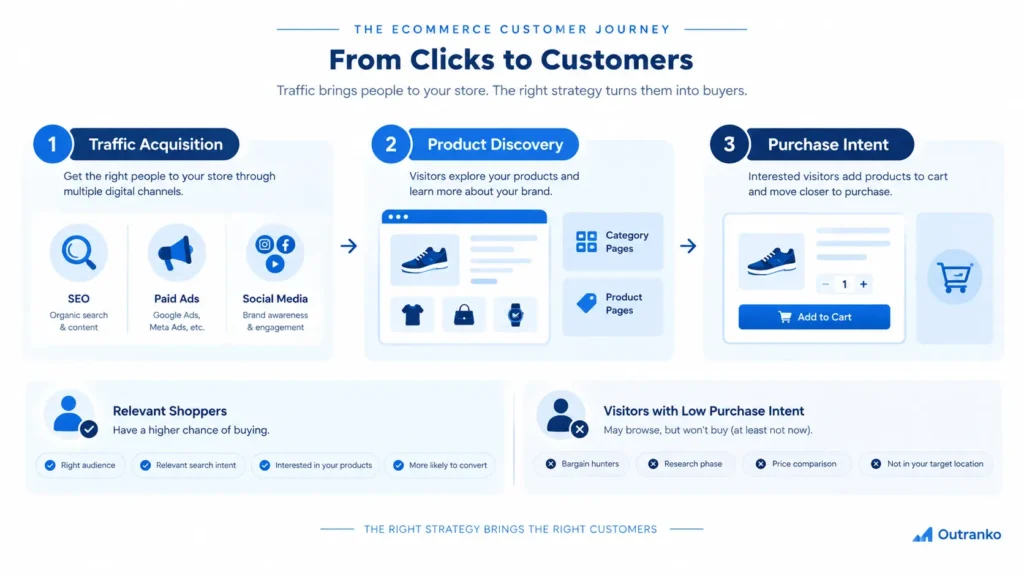
1. Your Traffic Comes From People Who Are Not Ready to Buy
Getting thousands of website visitors means very little if those visitors have no genuine interest in purchasing your products.
One common mistake in ecommerce digital marketing is focusing too heavily on traffic volume instead of audience relevance. Businesses sometimes run broad advertising campaigns, target unrelated interests or publish content that attracts visitors with no connection to their products.
Consider a premium jewellery brand running a social media giveaway. The campaign generates thousands of visits, but most visitors are interested in winning a free product rather than purchasing an expensive jewellery piece.
The campaign generates attention, but not necessarily potential customers.
How to fix it:
- Understand search intent: Identify whether visitors are researching products, comparing options or ready to purchase.
- Refine audience targeting: Focus advertising on people whose interests, location and purchasing behaviour align with your products.
- Match ads with landing pages: Send visitors directly to the product or collection featured in your advertisement.
- Analyse traffic quality: Compare product views, add-to-cart actions and purchases across different traffic sources.
An effective ecommerce marketing strategy focuses on attracting people who have a genuine reason to buy, rather than simply increasing website sessions.
2. Your Product Pages Are Not Convincing Enough
Imagine a customer finds your product through Google or an advertisement. They visit your product page, look at the photographs and check the price. But they cannot find important information about delivery, product specifications, returns or available sizes.
What happens next? They may leave and look for another seller.
Your product page is often the final place where customers evaluate whether your product is worth purchasing. Even a well-designed website can lose sales when essential buying information is missing.
How to improve your product pages:
- Write clear and descriptive product titles.
- Display pricing and product availability prominently.
- Include detailed delivery and return information.
- Add genuine customer reviews and ratings.
- Use visible calls to action such as Add to Cart or Buy Now.
- Provide accurate product specifications and variant options.
For example, a clothing store selling premium shirts should explain fabric quality, available sizesfitng, washing instructions, and delivery details.
Good ecommerce marketing services should consider product presentation and the actual buying experience together. Attracting visitors is not enough if the product page cannot answer their questions.
3. Your Product Descriptions and Images Fail to Communicate Value
A product description that says “Premium Quality, Best Design and Perfect for Every Occasion” does not give customers much useful information.
Shoppers want to understand what they are purchasing, how the product works and why it is suitable for their needs.
This is where ecommerce content marketing becomes important. Content should reduce uncertainty and help customers make informed purchasing decisions.
For instance, someone purchasing a white kurta may want to know whether the fabric is transparent, whether it includes a lining and how it fits. A generic description will not answer these questions.
How to fix it:
- Replace generic descriptions with product-specific information.
- Explain materials, dimensions, feature,s and practical benefits.
- Include high-resolution product images from multiple angles.
- Add close-up photographs to highlight important details.
- Use demonstration videos when product functionality needs explanation.
- Include FAQs based on actual customer questions.
Your product content should help shoppers imagine owning and using the product. Better information can make the buying decision easier without relying on exaggerated marketing claims.
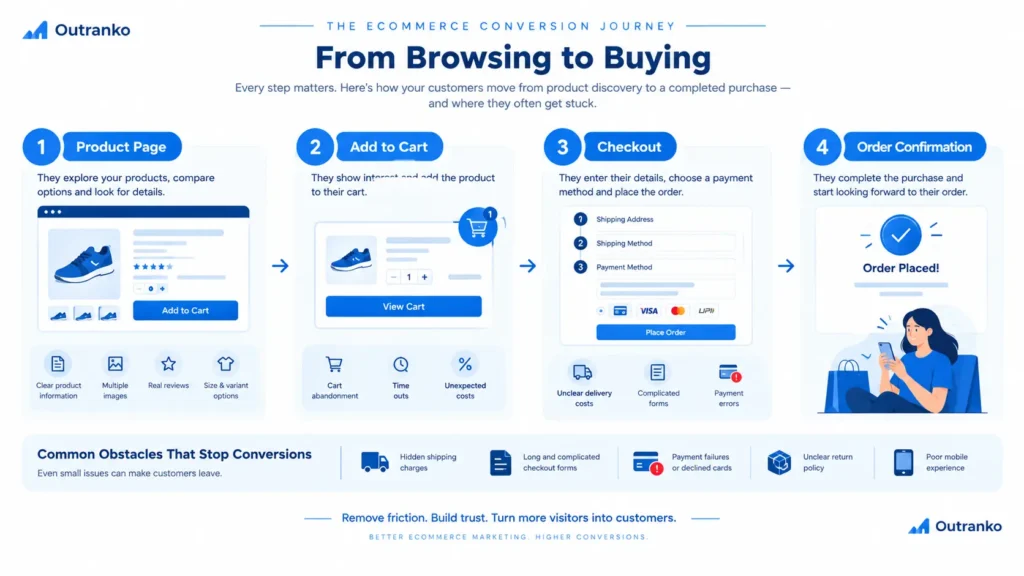
4. Your Checkout Process Creates Unnecessary Friction
A customer has selected a product, added it to their cart and reached checkout. But suddenly, they discover additional delivery charges, complicated registration requirements or payment difficulties.
The purchase journey becomes more difficult than expected.
Checkout friction is particularly frustrating because the customer has already demonstrated buying interest.
Consider a home décor store advertising a product for ₹799. During checkout, the customer discovers an additional ₹199 delivery charge that was not communicated earlier. The unexpected total may change their purchasing decision.
How to improve checkout:
- Offer guest checkout wherever possible.
- Avoid unnecessary registration requirements.
- Display shipping charges before the final payment stage.
- Provide payment methods suitable for your target customers.
- Keep checkout forms short and easy to complete.
- Display clear messages when payment attempts fail.
Test your checkout process regularly, especially on mobile devices. A small technical issue or confusing payment step can interrupt an otherwise smooth shopping experience.
5. Your Website Is Not Properly Optimised for Mobile Users
Many ecommerce customers discover products through mobile searches, social media advertisements, and messaging platforms.
If your website works well on desktop but creates problems on mobile, you may be making it unnecessarily difficult for customers to purchase.
Common issues include oversized images, slow-loading pages, overlapping pop-ups, difficult navigation, and buttons that are too small to tap.
How to improve the mobile experience:
- Optimise image sizes without compromising visual quality.
- Make navigation simple and easy to understand.
- Use readable fonts and appropriately sized buttons.
- Ensure product images display correctly on smaller screens.
- Remove unnecessary pop-ups and third-party scripts.
- Test product selection, cart functionality and checkout on actual mobile devices.
Do not optimise only your homepage. Test the entire customer journey, from opening a product page to completing a purchase.
A strong digital marketing and ecommerce strategy must account for how people actually browse and shop across different device
6. Your Ecommerce PPC Campaigns Generate Clicks Instead of Profitable Sales
Paid advertising can bring immediate traffic to an online store, but more clicks do not automatically mean more revenue.
One of the biggest ecommerce PPC mistakes is optimising campaigns around attention rather than actual purchasing behaviour.
For example, imagine an online clothing brand advertising a specific collection. The advertisement attracts interested shoppers, but instead of taking them to that collection, the website redirects everyone to its homepage.
Visitors must now search for the advertised products themselves. Some may leave before finding them.
How to improve Ecommerce PPC performance:
- Set up reliable purchase and conversion tracking.
- Match advertisements with relevant product or collection pages.
- Review search terms and audience targeting regularly.
- Monitor cost per acquisition alongside revenue.
- Consider product margins, shipping expenses, discounts, and returns.
- Pause or adjust campaigns that consistently attract irrelevant traffic.
Your ecommerce advertising strategy should connect the advertisement, landing page, and purchasing experience.
For businesses that need professional campaign planning and optimisation, Outranko offers PPC services to support paid advertising activities.
Remember: a campaign generating revenue is not necessarily profitable. Evaluate its contribution after considering the actual costs of fulfilling orders.
7. Your E-commerce SEO Strategy Targets the Wrong Searches
Paid advertising is not the only way to attract potential buyers. Organic search can also bring relevant visitors to your product and category pages.
However, an ecommerce website can struggle when its SEO strategy does not match what people are searching for.
Consider two searches:
- “How to clean silver jewellery”
- “Buy silver hoop earrings online”
The first person is looking for information. The second is showing a more direct purchasing interest.
Sending both visitors to the same type of page does not properly address their needs.
How to improve Ecommerce SEO:
- Target product-related searches with relevant product pages.
- Optimise category pages for broader shopping keywords.
- Write unique product titles and descriptions.
- Improve internal linking between relevant products, categories and blogs.
- Check whether important product pages are indexed by Google.
- Create educational articles that answer genuine customer questions.
For example, a jewellery website can publish an educational article about choosing silver jewellery and link it naturally to relevant product collections.
This creates a connection between informational content and commercial pages.
Outranko provides SEO services to help businesses improve organic search visibility. You can also explore our guide to content clusters in SEO to understand how related articles can be organised into a structured content strategy.
8. You Are Not Bringing Interested Visitors Back
Not every visitor purchases during their first website visit.
Some shoppers compare products, check prices, discuss purchases with family member,s or simply postpone their decisions.
If your marketing strategy focuses only on acquiring new visitors, you may overlook people who have already shown interest in your products.
This is where email marketing for ecommerce and retargeting become useful.
Practical ways to reconnect with potential customers:
- Abandoned cart emails: Remind shoppers about products they added to their carts.
- Product recommendations: Suggest relevant products based on previous interactions.
- Educational emails: Share product guides, comparisons, and useful information.
- Retargeting campaigns: Show relevant advertisements to eligible previous website visitors.
- Post-purchase communication: Recommend complementary products to existing customers.
For example, someone who views a laptop bag but does not purchase may benefit from an email explaining its storage capacity, material, and compatibility.
Social media marketing for ecommerce can also support product discovery and customer engagement. However, every follow-up should provide relevance rather than repeatedly asking people to buy.
Use appropriate consent, privacy practices,s and platform permissions when collecting customer information and creating advertising audiences.
9. You Are Not Tracking the Right Marketing Metrics
Sometimes an ecommerce business believes its marketing is performing well simply because website traffic and advertising clicks are increasing.
But without proper measurement, it becomes difficult to identify where potential customers are leaving.
Your analytics should help you understand the complete purchasing journey.
For example, if visitors view products but rarely add them to their carts, investigate product presentation, pricing,ng and availability. If many customers start checkout but few complete purchases, examine payment errors, delivery costs, and form usability.
Important ecommerce metrics to monitor:
- Conversion Rate: Percentage of visitors who complete a desired purchase.
- Add-to-Cart Rate: Percentage of visitors who add products to their carts.
- Cost Per Acquisition (CPA): Amount spent to acquire a customer.
- Average Order Value (AOV): Average revenue generated per order.
- Return on Ad Spend (ROAS): Revenue attributed to advertising relative to advertising expenditure.
- Cart Abandonment: The proportion of shopping carts that do not result in completed purchases.
Google Analytics 4 supports ecommerce event measurement, including product views, cart additions, checkout activity, and purchases. Refer to Google’s ecommerce measurement documentation when configuring your tracking.
Use the following diagnostic table to decide where to investigate first.
| What you observe | What to investigate |
|---|---|
| High traffic, few product views | Traffic relevance and navigation |
| Product views, few cart additions | Product information, price and presentation |
| Cart additions, few checkout starts | Cart usability and delivery charges |
| Checkout starts, few purchases | Payment issues and unexpected costs |
| Actual orders missing in analytics | Tracking implementation |
These patterns are diagnostic clues, not automatic proof of a particular problem. Compare consistent reporting periods and verify your tracking before making major marketing decisions.
How to Fix Your Ecommerce Marketing Problems: Start With the Biggest Obstacle
When your ecommerce store receives traffic but struggles to generate sales, spending more on advertising should not automatically be your first response.
Start by understanding the existing customer journey. Check where visitors arrive, which products they explore, how often they add products to their carts, and where they abandon the purchase.
Prioritise improvements according to the evidence:
- Identify the stage where potential customers leave.
- Investigate the most likely reason behind the problem.
- Implement one meaningful improvement.
- Monitor the relevant performance metrics.
- Compare results before making further changes.
A successful ecommerce marketing strategy does not depend on one advertising channel or a single SEO technique. It connects audience acquisition, product presentation, website experience, conversion optimisation, and customer retention.
For ecommerce brands, entrepreneurs and growing online businesses, the real opportunity is to make every part of the customer journey work together.
Need help improving your ecommerce marketing performance?
Outranko helps businesses approach digital growth through SEO, PP,C and digital marketing strategies. If your store is attracting visitors but struggling to convert them into customers, contact Outranko to discuss your marketing challenges and potential areas for improvement.
