


If you are publishing blog posts without a clear structure, you may already be losing rankings to competitors that use “Content Cluster in SEO”. Modern SEO is no longer about publishing random articles. Instead, it’s about building topical authority through structured and interconnected content. Content clusters improve your website rankings, increase brand visibility, and play an important role in SEO for businesses looking to build long-term organic growth. The first page that Google shows.
In this blog, you will learn :
- What are Content Clusters in SEO?
- Example of Content Clusters in SEO
- How Content Clusters in SEO Improve Rankings?
- Content Clusters vs Random Blog Posting
- Common Content Clusters Mistakes to Avoid
What are Content Clusters in SEO?
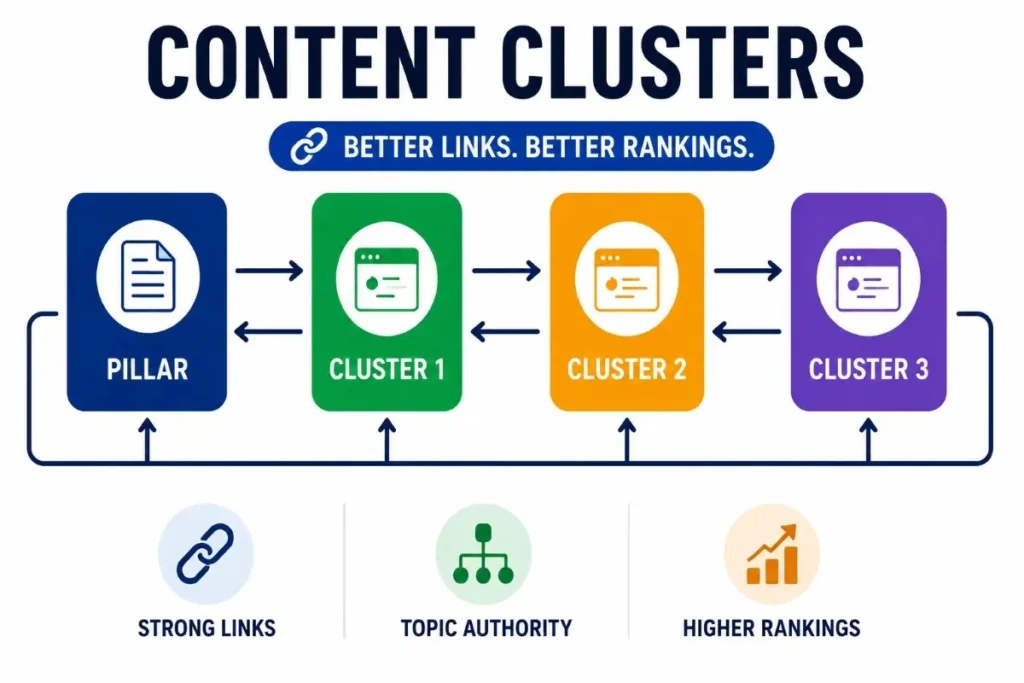
A content cluster is a group of interlinked pages that cover a topic comprehensively, helping search engines better understand your website and rank it higher in search results.
It includes
- pillar page(main topic page)
- Multiple cluster blogs (subtopics)
- Strong internal linking between all pages
.
Example of Content Clusters in SEO
Content cluster is an excellent strategy for boosting your page rankings and can be highly effective in bringing organic traffic. Furthermore, a strong pillar page joins multiple cluster pages and provides users with a roadmap for what to explore next.
Let’s understand with an example.
Pillar page ( main topic page )
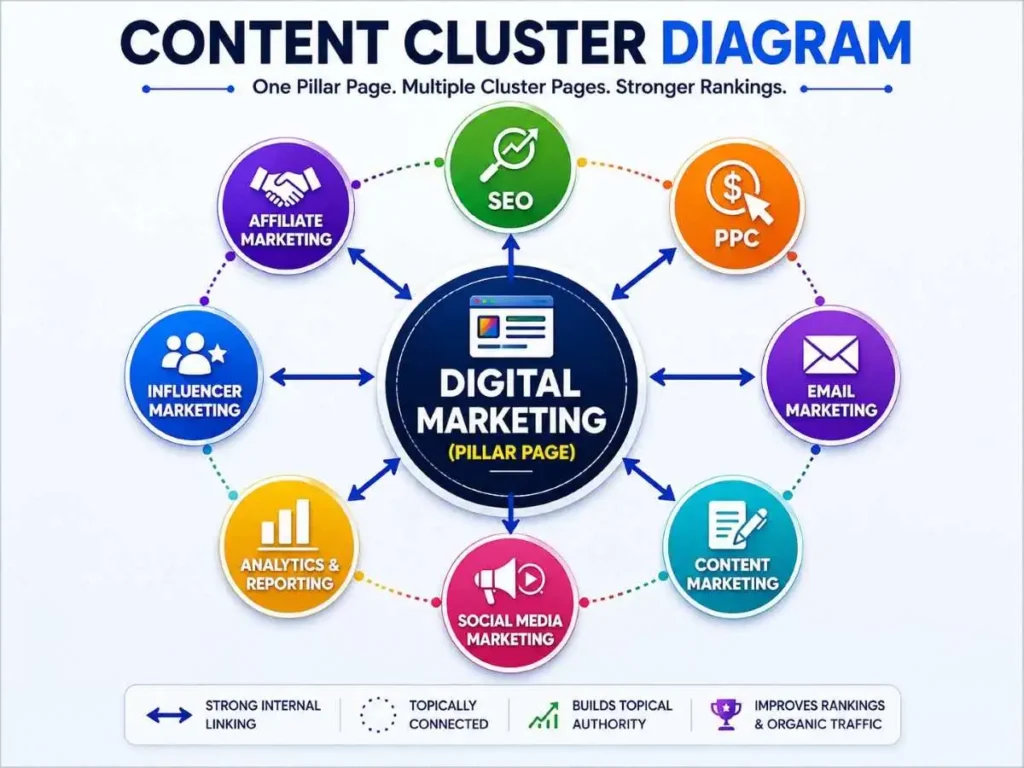
You have a Digital marketing agency, and you write a blog on “Digital Marketing: Expense or Investment.” This blog serves as a pillar page and the main authority page for the topic. It’s included.
- What is Digital Marketing?
- Channels Of Digital Marketing
- How It Helps Businesses
- Is It Really An Investment or an Expense
- Benefits
- Conclusion
Cluster pages (supporting blogs)
From this pillar page, you can create detailed supporting articles like:
- What is SEO in digital marketing
- Social media marketing guide
- Google Ads explained
- Email marketing strategy
- Benefits of PPC advertising: generating ROI
These are your cluster content pages that help you with internal linking of pillar pages and improve your website’s ranking.
Interlinking between cluster pages
Strong internal linking is the foundation of a successful content cluster. in addition, it helps both users and search engines navigate your content more effectively.
- The cluster blogs link back to the pillar page
- The pillar page links to all sub-blogs
- Related cluster blogs can also link to each other
After linking all sub-blogs with pillar pages, it helps Google clearly understand your website’s topic and improves ranking.
How Content Clusters in SEO Improve Rankings
Content clusters are a highly effective strategy for boosting your website’s ranking. Here are some of the best ways it helps businesses achieve better SEO results.
Build topical authority:
When you create a significant amount of content around a pillar page, Google begins to recognize your website as an authority in that field. As a result, your pages can start appearing in search engine results for a wider range of related keywords. Many SEO professionals and agencies use content cluster strategies to improve topical authority and long-term organic growth. For example, agencies such as Outranko SEO Company Jaipur often implement structured content strategies to help businesses improve their search visibility.
Improve search results
Content clusters make it easier for search engines to connect related pages and deliver better results to users. Moreover, people now use broad topics instead of exact keywords. Structured content has become more important than ever.
Improve user experience and internal linking
A well-structured content cluster strengthens internal linking between pillar and cluster pages, making it easier for users and search engines to navigate your website. Additionally, increased user session duration can also contribute to improved SEO performance.
Dwell time signals
Dwell time signals are proof of effective content cluster- for example, when a user moves from one cluster page to another without returning to Google, it signals to the search engine that your content successfully satisfied search intent.
Better Crawlability
A well-structured content cluster improves your website’s crawlability by creating similarly, multiple internal links between related pages. These links help Googlebot discover, crawl, and index new content more efficiently. When cluster pages are connected to a pillar page and to each other, search engines can better understand the relationship between topics on your website.
Content Clusters vs Random Blog Posting
1. SEO Authority
Content Clusters:
All articles support a single topic and strengthen each other through internal linking. This helps Google recognize your website as an authority, increasing the chances of ranking for multiple related keywords.
Random Blogs:
Each article covers a different topic with little connection to other content. As a result, Google struggles to understand your website’s expertise, which can lead to weaker rankings.
2. Internal Linking
Content Clusters:
Related pages are connected through a structured internal linking strategy. This helps search engines understand content relationships and improves the ranking potential of every page.
Random Blogs:
Many posts remain isolated without meaningful internal links, making it harder for search engines to determine their relevance and value.
3. Keyword Coverage
Content Clusters:
A content cluster can target keywords across different stages of the buyer journey, from awareness to consideration and decision-making. This allows a single cluster to rank for hundreds of related search queries.
Random Blogs:
Each post typically targets one keyword without supporting a broader content strategy, limiting overall keyword reach.
4. User Experience
Content Clusters:
Users can easily navigate from one related article to another, increasing engagement, session duration, and content discovery.
Random Blogs:
Visitors often read one article and leave because there is no clear path to additional relevant content.
5. Long-Term ROI
Content Clusters:
As new cluster pages are added, the entire content ecosystem becomes stronger. Older content continues to gain authority and deliver traffic over time.
Random Blogs:
Older posts often become outdated and disconnected. Traffic growth depends heavily on continuously publishing new content.
Common Content Clusters Mistakes to avoid
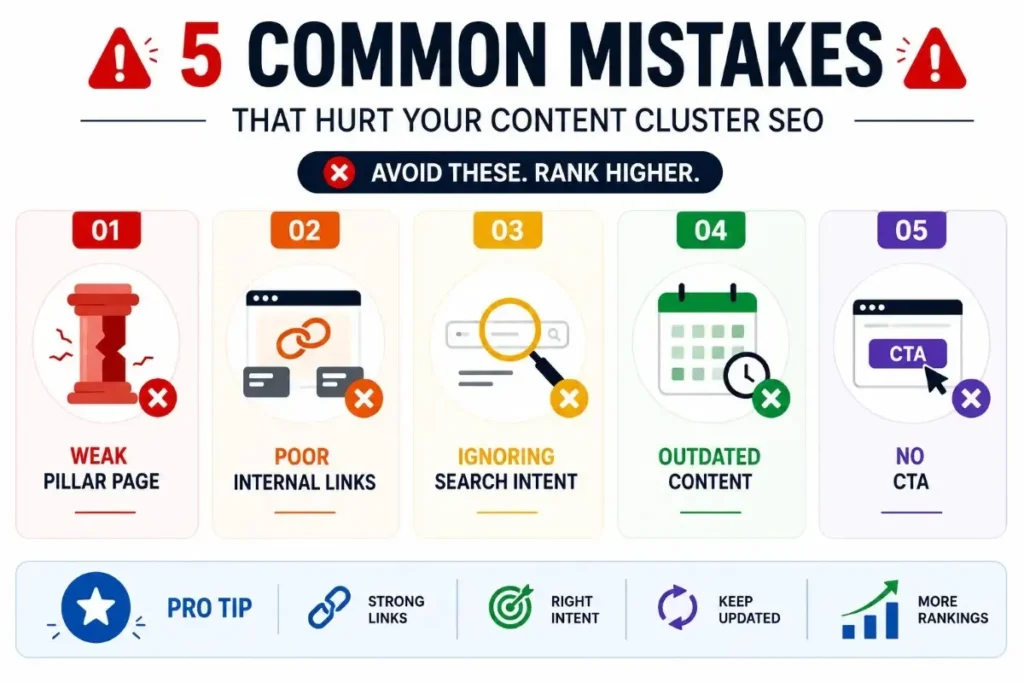
1. Weak pillar page
Always know that your pillar page is the foundation of a content cluster. It’s a main hub; however, many websites make it too short, too broad. Without a strong pillar, the entire cluster loses direction.
2. Poor internal linking structure
Similarly, many websites create lots of pages, but they do not connect them properly. This makes it harder for search engines to understand how the pages are related.
3. Forgot to refresh and update content
Your content cluster should keep evolving with your website over time, add related topics or build new sub-clusters when needed, like AI in tech.
4. Ignoring search intent
Every content piece in your cluster should match what your audience is actually looking for. To get more leads, you need to understand their needs, not your interests, and answer their question early.
5. Ignoring the call to action
ignoring the call to action means not telling users what to do next after reading your content. Without a CTA, readers may leave your page without taking any action.
Conclusion
Content clusters improve SEO by organizing blogs into a structured system instead of random posts. A pillar page connects to related cluster content through internal links, boosting topical authority, crawlability, and organic traffic over time.

1 comment on “Content Clusters in SEO: Why Random Blogs Don’t Rank Anymore”