


Generative Engine Optimization (GEO): SEO vs GEO Explained for 2026
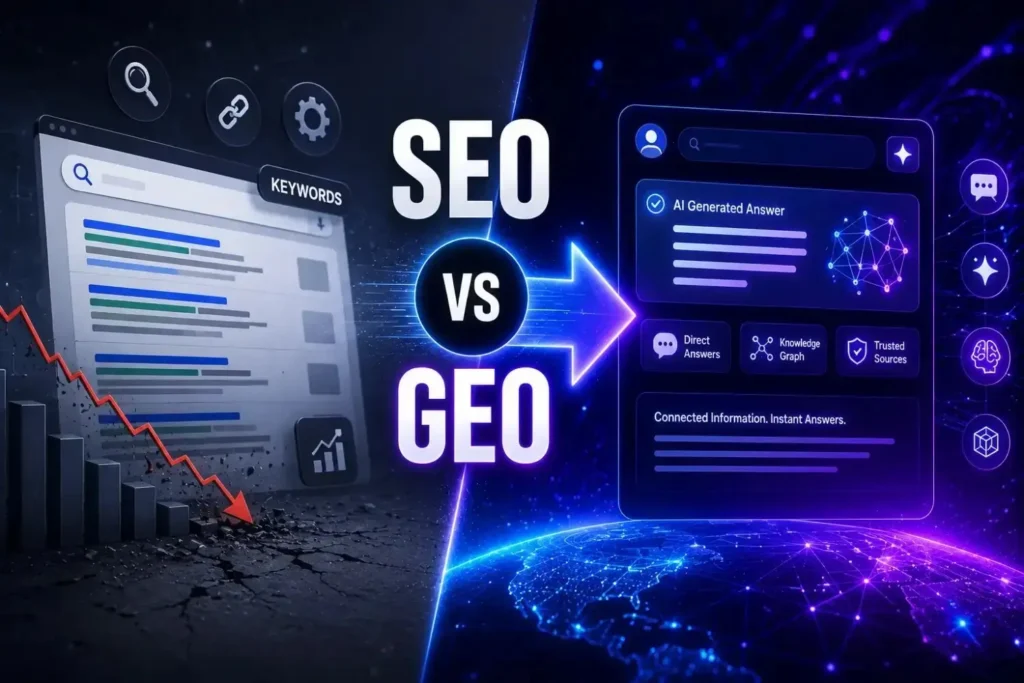
In the digital marketing industry, a new buzzword that is gaining popularity is “Generative Engine Optimization ” replacing Search Engine Optimization.” With the rapid growth of AI-powered platforms like ChatGPT, Claude, Perplexity, and Gemini.
According to a TechCrunch report, ChatGPT has reached 900 million weekly active users and more than 1 billion monthly active users, while Google AI overview now reaches over 2 billion monthly active users. It means traditional search engines are slowly being replaced by Generative engine optimization platforms.
As AI search grows, rankings on Google alone are not enough. Businesses now need content that AI systems can understand, trust, and cite in their responses through Digital marketing services. This is where Generative Engine Optimization(GEO) comes in.
In this guide, you’ll learn
- What is GEO
- SEO vs GEO
- Why GEO matters in 2026
- How generative engine optimization works
- 5 best GEO strategies to improve AI visibility
- Future of generative engine optimization
What is Generative Engine Optimization(GEO)
“Generative Engine Optimization (GEO) is the process of optimizing content so that AI-powered search engines and generative AI platforms can understand and trust and prefer it in their response.“
How Do AI Search Engines Use Content?
When someone asks a question about AI tools, their systems analyze information from websites, blogs, and other online sources to generate direct answers. Instead of simply displaying a list of links like traditional search engines, AI-powered search tools gather key information from multiple sources, identify the most useful insights, and present them in a clear, conversational format.
Here is how AI search engines use content
- They collect and analyze data from online sources.
- They identify key information such as facts, explanations, and answers.
- They compare information from multiple sources to find the most relevant content.
- They generate a direct response instead of simply showing a list of links.
GEO vs SEO : what’s the difference
Generative Engine Optimization (GEO) and Search Engine Optimization (SEO) are closely related concepts, but they focus on different ways to improve visibility.
SEO helps improve a website’s ranking on traditional search engines like Google, Yahoo, and Bing. While GEO focuses on making content more discoverable and usable by AI-powered search platforms like ChatGPT, Claude, and Gemini.
Understanding the difference between SEO and GEO helps businesses develop more effective strategies.
How AI Changed Search Behaviour
ChatGPT is used by more than 900 million people every week and nearly 1 billion monthly active users.
Google announced that the Gemini app has reached 900 million monthly active users.
Claude has grown rapidly and is estimated to have around 220 million monthly active users in 2026.
These numbers show that AI is no longer a niche technology. Today, everyone uses generative engines for searching for information, making modern digital marketing strategies, learning new skills, writing content, and conversation for decision-making.
People want Answers, Not Search Results
If we look at the traditional search process, we can identify a five-step pattern.
- User types a query
- Gets a list of links
- Chooses the most relevant results
- Read article
- Find the answer
This is a long process, and you’re not always sure you’ll find a relevant answer to your queries, but something is changing. however generative. search engine works differently Users type a query (ask a question), then these generative engines collect all the related data and give answers in a conversational way.
The New Operating System For Knowledge Work
AI tools are no longer used only for searching for information online. Today, they have become powerful assistants that help people complete a wide range of personal and professional tasks. As AI technology continues to evolve, its use case is expanding far beyond traditional searches
People now use AI:
- Writing and content creation
- Coding and software development
- Customer support and communication
- Learning new skills and concepts
- Research and analysis
- Marketing and SEO tasks
How Generative Engine Optimizations Work
As more people use AI tools to find information, GEO helps to ensure that your content can be easily understood and trusted by these systems. The better AI understands your content, the more likely it is to include it in its responses. But here is a question about how GEO works.
Entity Optimization
Entities are specific people. Brands, products, places, or concepts that an AI system can accurately identify by providing relevant topics; you help AI understand what your content is about. When you mention relevant entities and provide sufficient context around them, you help AI systems better understand what your content is about.
Topical Authority
Topical authority is built when your website continuously publishes high-quality content around a specific topic. Creating content clusters, covering related subtopics, and answering user questions helps establish your site as a trusted source
Structured Content
AI systems prefer content that is organized and easy to understand. Using clear headings, subheadings, bullet points, tables, and FAQs helps generative engines extract and present information accurately.
E-E-A-T Signals
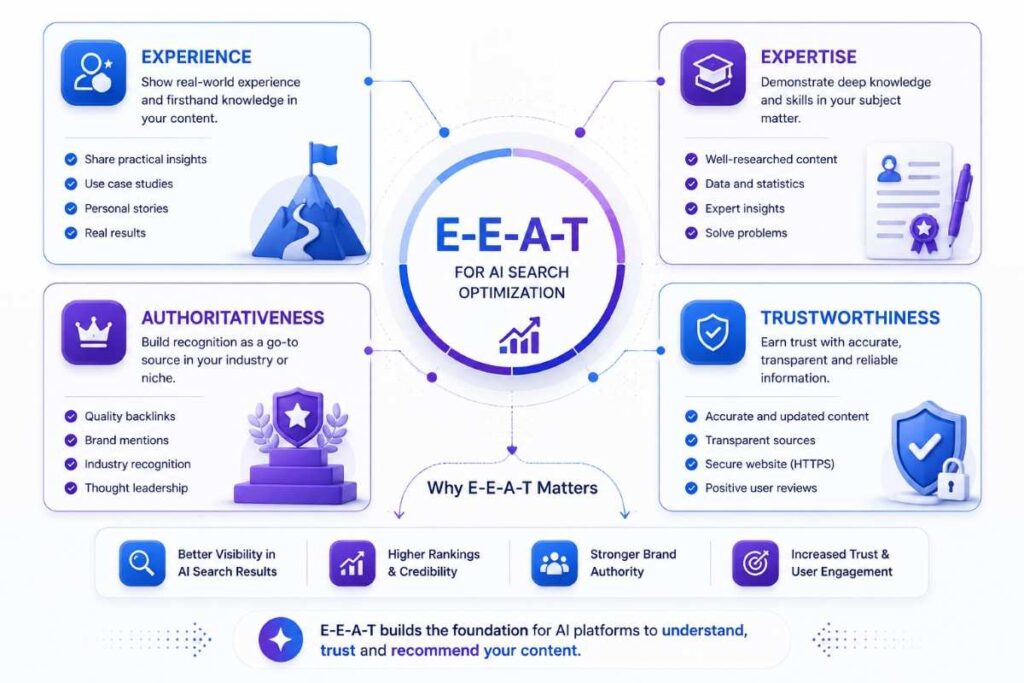
E-E-A-T stands for Experience, Expertise, Authoritativeness, and Trustworthiness. Generative engines prefer content that comes from reliable and knowledgeable sources. Showing real experience, providing accurate information, and building trust with your audience can improve the chances of your content being used in AI-generated answers.
5 Best GEO Strategies to Improve AI Visibility For Businesses
1. Create comprehensive content
AI engines prefer content that covers the entire topic. Instead of providing only a definition, include examples, challenges, FAQ, and practical tips to cover the topic comprehensively. Well-structured, detailed content helps AI systems better understand the context of your topic, increase topical authority, and AI trusts your content and ranks it in generative engines.
Example: If you write an article on what GEO is, DON’T just write the definition of GEO. Also include
- What is generative engine optimization(GEO)
- How does GEO work
- GEO vs SEO
- Why is GEO important
- Benefits of GEO
- Challenges of GEO
- GEO best practices
Covering these topics helps create more comprehensive content and improves the chances of your content being understood and referenced by AI- powered search engines.
2. Use Schema Markup
Schema markup is a special code(structured code) that is added to a website’s HTML. Its purpose is to help search engines and AI systems understand the exact meaning of the context of your content.
Example
If your article includes an FAQs section such as:
question = What is GEO
answer = GEO is the process of optimizing content for AI-powered search engines.
Then FAQ schema helps search engines and AI systems clearly understand the question-and-answer structure of your content. This makes it potentially surface your FAQs in search results and AI-generated responses.
3. Answer User Questions Directly
AI-powered search engines are designed to provide quick answers to users in a conversational way. Traditional search engines like Google and Bing that primarily rank web pages. AI systems often find specific information from the internet and use it to generate responses.
Example
Weak answer: GEO is a broad concept that involves many optimization techniques and strategies used across different platforms to improve concept performance
This answer is not good and does not clearly explain what GEO is:
Strong answer:
Generative engine optimization(GEO) is the process of optimizing content so AI-powered search engines and generative AI platforms can understand, trust, and reference it in their generated answers
4. Strengthen Internal Linking
Internal Linking Is All About Connectiong Your Main Pages To Other Realetedf Pages Of Website If you create meaningful connections between related pages rather than isolated articles. This creates a structured content network that benefits both users and search.
Example: Suppose you are writing an article about “GEO vs SEO”. Instead of treating it as a standalone page, you can link to other relevant resources
Such as:
- What is generative engine optimization
- Content clusters in SEO
- Schema markup guide
- How generative engines work
5. Establish Author Authority
Author authority plays an important role in generative engines’ ability to look beyond keywords and rankings. AI-powered search engines and AI platforms provide users with accurate and trustworthy information. As a result, they are more likely to value content created by individuals who have genuine expertise, experience, and credibility in their fields.
Example
Author bio:
Amit Sharma is a ppc consultant who has 5 years of experience in digital marketing. He publishes articles on their website every week and gives ideas about which ads perform better, how to conduct A/B testing, Meta ads’ new features, etc.
Future of Generative engine optimization
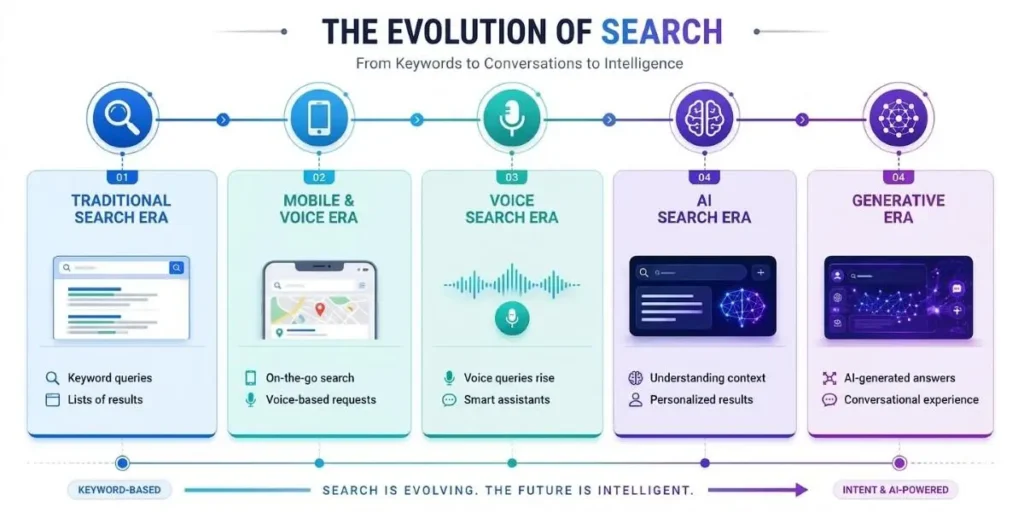
As the volume of AI searches continues increased Generative engine optimization(GEO) is become important part of human’s daily life. The way people search for information will keep evolving; people depend on AI platforms, and generative engines will become a part of ordinary life in the future. It helps people in these ways
- More people will use AI search tools to find information
- Reliable content is more important
- GEO will become as important as traditional SEO
- Search will combine text, images, videos, and voice
As AI-driven searches continue to rise, new AI search engines are being launched in the market; however, people are still utilizing traditional search engines. Both approaches have their place in the marketing landscape of the future, though AI platforms are now undergoing a complete update themselves.
GEO is not replacing SEO—it’s becoming an important extension of it.
