


D2C marketing: digital strategies to grow your business
Launching a D2C brand is the easy part. Getting people to find it, trust it and buy again is where the work starts. With no retailer or distributor selling for you, your brand has to win every customer directly, through search, social media, paid ads and each small moment that shapes the buying experience.
That is what D2C marketing is. Done well, it brings the right people to your store, turns visitors into buyers, and gives them a reason to come back after the first order. This guide covers the channels worth your time, how to pick a mix that suits your numbers, and the metrics that show whether the marketing makes money.
What D2C marketing actually means
D2C marketing is everything a direct-to-consumer brand does online to attract customers, convert them and keep them buying.
D2C stands for direct-to-consumer: the brand makes or sources its own products and sells them through its own website, app or social channels instead of leaning only on distributors, retailers or marketplaces.
Because the brand owns the sale, it also owns the customer relationship, and it pays for every acquisition itself.
D2C marketing vs. traditional Ecommerce marketing
| Factor | General ecommerce marketing | D2C marketing |
|---|---|---|
| Who owns the customer | Often shared with a marketplace or retailer | You do, including email, phone number and purchase history |
| Role of the brand | Product and price can carry the sale | Story and trust carry more of the sale, since shoppers can't compare you on a familiar shelf |
| Margin | Retailer or marketplace takes a cut | You keep the margin and fund every acquisition |
| Where growth comes from | Traffic and listings | Acquisition first, then repeat orders and referrals |
| Data | Limited on marketplaces | First-party data for email, retention and product decisions |
The practical result: you can’t judge D2C marketing by first-order revenue. A customer you pay for today only becomes profitable if the numbers hold up across their later purchases.
Why a digital-first approach fits D2C
Digital channels let a brand reach narrow audiences, test messages cheaply and see which marketing led to which sale. A new D2C brand has no shop footfall, so it has to create its own demand, and online is where that can be done on a small budget with fast feedback.
It isn’t easy, though. Attention is crowded, and thousands of brands run the same Instagram ad format. What sets brands apart is knowing exactly who the product is for and measuring honestly.
Start with unit economics, not channels
Before you pick a channel, work out what you can afford to pay for a customer. Four numbers decide it:
- Average order value (AOV): what a typical order brings in.
- Gross margin: what’s left after product cost, packaging, payment fees and shipping. If you offer cash on delivery, count the cost of returned or refused orders too.
- Purchase frequency: how often a customer buys again within a year.
- Customer acquisition cost (CAC) ceiling: the most you can spend to win a customer and still make a profit over a period you’re comfortable with.
Here’s an illustration with made-up numbers, not a benchmark. Say a home-fragrance brand has an AOV of ₹1,200 and a gross margin of 55 percent after all variable costs. Gross profit on a first order is ₹660. If it costs ₹900 in ads to win that customer, the brand loses ₹240 on the first order.
The business only works if enough of those customers reorder. So retention isn’t an optional extra here. It decides whether the ad spend makes sense at all.
A brand selling a consumable that people reorder every couple of months can accept a higher CAC than one selling something bought once every few years. That’s why copying another brand’s channel mix or target ROAS without checking your own margin is risky.
8 digital marketing strategies for D2C brands
No brand needs all eight at full strength on day one. Treat the list as a menu, then use the channel table further down to decide where to begin.
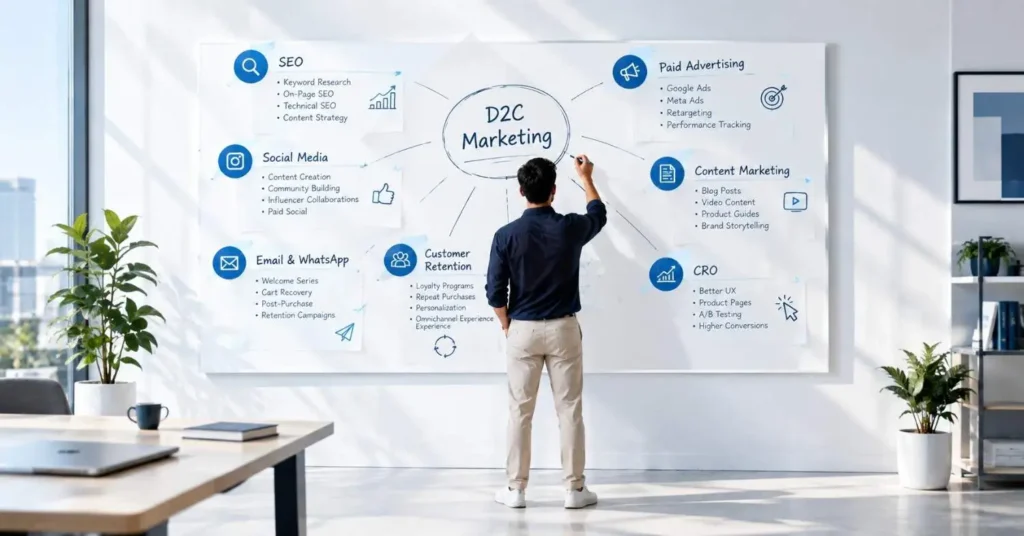
1. Search engine optimization (SEO)
SEO puts your products in front of people who are already searching for what you sell. It’s slower than ads, but the traffic doesn’t stop when you stop paying, which matters for your D2C customer acquisition cost over time.
For D2C, ecommerce SEO mostly comes down to three things:
- Category and product pages that match how customers describe the need. Write original descriptions, show reviews, answer common questions on the page, and use the words buyers use instead of internal product codes.
- A clear site structure. Google’s ecommerce documentation recommends linking from menus to category pages, from categories to subcategories, and from subcategories to products so crawlers can reach everything. It also recommends sharing product data with Google and adding relevant structured data to product pages.
- Content for the questions people ask before buying: how to choose, what the ingredients or materials mean, comparisons, usage guides.
Measure organic revenue and organic-assisted orders, not just visits. If you want help with the technical and content side, Outranko’s SEO services cover this kind of work.
2. Social media marketing
Social is where most D2C brands first get noticed, so the content needs a job. Some formats that work:
- Product demos in real situations, so people see the benefit and not just the pack shot.
- Behind-the-scenes posts about the team, the production process and why the brand exists.
- Customer stories: reviews, testimonials and user-generated content.
- Public answers to common questions, which removes hesitation before it turns into an abandoned cart.
Test different hooks, visuals and formats, and tie each post to a goal such as awareness, traffic or sales. When an organic post does well, turn it into an ad. Posting daily for the sake of it is a waste. A few pieces that fit your audience and positioning will do more. If you’d rather hand this off, Outranko offers social media marketing for brands.
3. Paid advertising and ecommerce PPC
Paid ads buy you attention while organic channels mature. They usually split three ways:
- Search and shopping ads catch people already looking for a product type. Intent is high, and so is the competition on popular terms.
- Paid social ads create demand among people who didn’t know they needed you. Creative does most of the work, so plan to test hooks, offers and formats regularly.
- Retargeting brings back visitors who looked but didn’t buy. It can look very efficient, partly because those people were close to buying anyway, so judge it against total business results and not its own dashboard.
Before scaling any campaign, know your break-even return on ad spend (ROAS). With a 55 percent gross margin after variable costs, you need about ₹1.82 in revenue for every ₹1 of ads just to break even on the first order (1 divided by 0.55). That’s very different from a generic 4x target, and it changes with each product. Performance marketing works best when the targets come from your own margins.
The page your ad lands on matters as much as the ad. Outranko’s Google and Meta Ads service lists tracking and conversion-focused landing pages as part of its approach.
4. Content marketing
Content earns trust before a purchase and keeps working long after you publish it. For a D2C brand that means buying guides, comparison pages, how-to videos, founder stories, ingredient or material explainers and customer case stories.
A simple test: for every piece, can you name the customer question it answers and the next step it leads to? If not, skip it. Repurpose one strong piece across blog, short video, email and ads. To stop the program from turning into random posts, group content into clusters around the topics your customers care about. Outranko’s article on content clusters in SEO explains how.
5. Email marketing and automation
Email and messaging are where one-time buyers become repeat customers, because you own the contact details. Set up a few automated flows before you send a single newsletter:
- Welcome series: who you are, what you stand for, your bestsellers.
- Cart and browse reminders: a helpful nudge, not a discount by default.
- Post-purchase: order updates, how to use the product, a review request.
- Replenishment and win-back: a reminder when the product is likely to run out, and a message to lapsed customers.
WhatsApp is widely used in India and works well for order updates and reorder reminders. Message only people who’ve clearly agreed to it, keep the messages useful, and test how often is too often. Choose channels by where your customers actually respond, not by assumed open rates.
6. Influencer marketing and user-generated content
Creators lend you borrowed trust, but only when the fit is right. Pick people whose audience matches your buyer, check the quality of their engagement, and ask whether their followers would actually buy your product. Give each creator a trackable link or code so you know what drove orders.
Longer partnerships usually work better, because creators get time to learn the product and talk about it naturally. If you plan to reuse their content in your ads, agree on usage rights in writing, and disclose paid partnerships as advertising rules and platform policies require.
User-generated content (UGC) such as reviews, photos and unboxing clips acts as social proof on product pages, in ads and in email. Ask for it after delivery, when satisfaction is highest, and make it easy to submit.
7. Conversion rate optimization (CRO)
Traffic is expensive, so a site that converts better lowers your effective acquisition cost. Baymard’s research puts average cart abandonment at about 70 percent across 49 studies, though many of those shoppers were just browsing. Baymard also estimates that fixing checkout usability problems could lift conversion for the average large site by around 35 percent. Read that as a sign of how much friction can exist, not a promise for your store.
Places to start:
- Show delivery cost, timing and return terms before checkout. Surprise costs are a common reason people leave.
- Put reviews and real product photos near the buy button.
- Run the full purchase flow on a mid-range phone on a normal mobile connection.
- Offer the payment methods your customers expect.
- Change one thing at a time, and give each test enough traffic to mean something.
8. Customer retention and omnichannel marketing
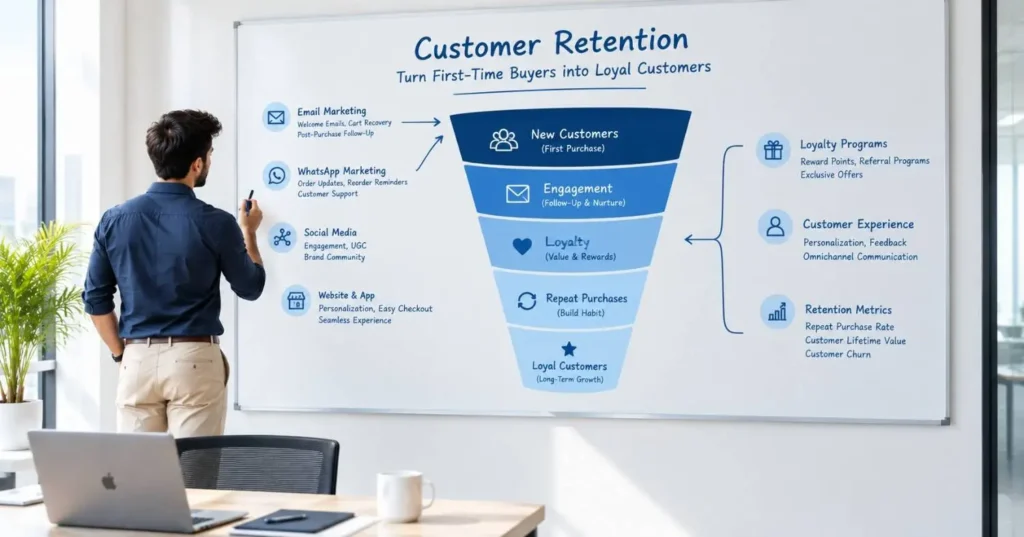
Retention is where D2C economics are won or lost, as the fragrance example showed. Options include subscriptions or replenishment reminders for consumables, a loyalty or referral program, proactive customer service, and product education that helps people get value from what they bought.
Omnichannel simply means the experience feels connected across web, email, WhatsApp, social and any marketplace or offline presence. Hold the relationship on your own website and messaging channels, and use the other channels for awareness. Keep customer data joined up, so someone who bought last week doesn’t get a first-purchase offer.
How to choose channels for your brand
Your channel mix depends on margin, AOV, purchase frequency, audience, product category and budget. The table below gives starting points. They’re judgments, not rules, so test and adjust.
| Your situation | Sensible starting focus | Why |
|---|---|---|
| New brand, small budget, unfamiliar product | Social content, creator seeding, email capture, basic SEO, small paid tests | Builds awareness and an owned list without big ad spend |
| Product people already search for | Search and shopping ads, SEO category pages | Demand exists, so capture it |
| Visual, low-AOV or impulse product | Short video creative, creators, paid social, strong retention flows | Attention is the barrier, but thin margins make repeat orders essential |
| High-AOV, considered purchase | Content and SEO, reviews, retargeting, email or WhatsApp follow-up | Buyers research for longer and need reassurance |
| Consumable or replenishable product | Retention flows and subscriptions alongside acquisition | Repeat orders can support a higher CAC |
How to build a D2C marketing strategy
Define your audience and value proposition
Write one sentence that says who the product is for, what problem it solves and why it’s different. If a customer can’t repeat it, your marketing will cost more because people need extra touchpoints to understand you. Interview recent customers and read your reviews for the exact words they use.
Select channels based on goals and budget
Go back to the unit economics section. Pick one or two acquisition channels you can run properly, plus one retention channel (email or WhatsApp). Spreading a small budget across six channels gives you data too thin to learn from. Set a test budget you can afford to lose, and a rule for when a test gets more money or gets stopped.
Create a content and campaign calendar
Plan around product launches, seasonal buying periods and the festivals that matter in your category. Work backward from each date: creative and landing pages first, then ads, then email and messaging. Keep a weekly slot for testing new creative.
Set KPIs and review performance
Pick a small set of metrics (the next section lists them), decide how often you’ll review them, and write down what you’ll do when a number moves. A weekly look at acquisition and a monthly look at retention and profit is a workable start.
How to measure D2C marketing performance
Use a small, steady set of metrics and read them together. A good number on one can hide a problem on another.
| Metric | How to calculate | What it tells you |
|---|---|---|
| Conversion rate | Orders divided by sessions | How well your site turns visits into orders |
| Customer acquisition cost (CAC) | Acquisition spend divided by new customers | What it costs to win one customer. Track it by channel |
| Return on ad spend (ROAS) | Revenue attributed to ads divided by ad spend | Ad efficiency. Compare it to your break-even ROAS, not a generic target |
| Blended return | Total revenue divided by total marketing spend | A whole-business view that avoids double-counting across platforms |
| Customer lifetime value (LTV) | AOV multiplied by gross margin multiplied by expected orders per customer | The gross profit a customer brings over time |
| Repeat purchase rate | Customers with two or more orders divided by all customers | Whether people come back |
| Payback period | Time for a customer's gross profit to cover their CAC | How long your cash is tied up |
| Organic traffic and organic revenue | Visits and orders from unpaid search | Whether SEO is building an asset |
Two cautions. First, each ad platform reports its own conversions, and the totals often add up to more than your real orders. Compare platform numbers with your store’s actual orders, and add a simple checkout question like “How did you hear about us?”. Second, if you offer cash on delivery, measure revenue after returns and refusals, or your ROAS will look better than your profit.
Common D2C marketing mistakes
- Scaling ads before the economics work. If CAC is higher than first-order gross profit and few customers reorder, more spend deepens the loss. Fix the margin, the offer or retention first.
- Trusting platform dashboards alone. Platforms credit themselves. Reconcile against real orders and a blended view.
- Relying on one channel. A single source of customers leaves you exposed to cost hikes and policy changes. Build a second and a third over time.
- Discounting by default. Constant offers teach customers to wait and attract buyers who rarely return. Track whether discount-led customers reorder.
- Ignoring retention until acquisition slows. Set up basic email or WhatsApp flows early.
- Neglecting the site. Paid traffic sent to slow, confusing product pages is wasted. Fix the page before buying more clicks.
- Chasing follower counts. Choose creators for audience fit and measurable orders, not reach.
- Copying another brand’s playbook. Their margins, products and customers aren’t yours.
How a D2C marketing agency can help
In-house teams are usually small, and D2C marketing spans a lot of skills: search, paid media, creative, analytics, email and site optimization. An ecommerce marketing agency can add specialist hands, an outside view of your numbers, and speed. It can’t fix a weak product, thin margins or fuzzy positioning, and no agency can promise results in advance.
Whether you hire Outranko or anyone else, ask these questions:
- How will you work out what we can afford to pay for a customer before spending our budget?
- How will tracking be set up, and how will you report results against real orders?
- Which channels would you start with for our product, and why not the others?
- What will you test in the first 90 days, and how will we decide what to scale?
- Who will do the work, and how often will we talk?
Outranko is a digital marketing agency in Jaipur. Its website lists SEO, social media management, Google and Meta Ads, website development and business consultancy, and describes a simple process: understand the business, build a strategy, then execute, track and improve. If you’d like an outside view of your D2C marketing, you can book a meeting with the Outranko team, or look at its digital marketing packages first.
Frequently asked questions
What is D2C marketing?
D2C marketing is the set of online activities a direct-to-consumer brand uses to attract, convert and retain customers without relying on retailers or marketplaces. It covers SEO, paid ads, social media, email, WhatsApp, influencers and retention, and it should be measured against profit, not only revenue.
What is the best D2C marketing strategy?
There’s no single best one. It starts from your margins, order value, repeat-purchase pattern and audience. Most brands do well combining one or two acquisition channels with a retention channel like email or WhatsApp, and measuring results against profit.
Which digital marketing channels work best for D2C businesses?
It depends on the product. Search ads and SEO suit products people already look for. Short video, creators and paid social suit visual or discovery-led products. Email and WhatsApp suit almost any brand with repeat purchases. Use the channel table above as a starting point and test.
How can D2C brands get more customers online?
Fix what you already have first: product pages, reviews, delivery information and checkout. Then test paid search or paid social, add creator partnerships with trackable codes, and publish content that answers pre-purchase questions. Track CAC by channel so you can move budget toward what works.
Is SEO important for D2C brands?
For most, yes. It brings in people who are actively searching and keeps working without per-click costs. It takes time, so it usually runs alongside paid channels instead of replacing them. Start with well-structured category and product pages.
How much should a D2C brand spend on digital marketing?
There’s no reliable percentage. Work backward: set your CAC ceiling from gross profit and repeat purchases, estimate how many customers you want, and fix a test budget you can afford to lose. Raise spend only when channel-level CAC and payback stay within your limits.
Where to start with D2C marketing
D2C marketing isn’t about finding one magic channel. It’s a loop: attract the right people, convert them on a site that earns their trust, and give them reasons to return. Get your unit economics clear first, start with the channels that fit your product, and judge everything against real orders.
If you’d like a second pair of eyes on your funnel, talk to the Outranko team.
